
What Is a Hydraulic Torque Wrench Pump System


A wind turbine tower bolt doesn’t care about your deadline. It needs 50,000 to 100,000 Nm of torque — delivered with accuracy, consistency, and zero margin for error. That’s the exact problem a Hydraulic Torque Wrench Pump system was built to solve.
The system has four working parts:
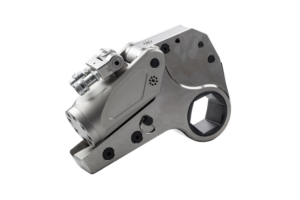
- Wrench head — a cylinder and piston connected to a square drive; it turns the socket onto the nut in small, controlled steps
- Pump unit — runs on an electric motor or pneumatic drive, turning mechanical energy into hydraulic pressure up to 70 MPa (10,000 PSI)
- Hydraulic hoses — rated to 700 bar, reaching up to 10 meters so you can work in remote or tight spaces
- Pressure control circuit — adjustable from 40 to 700 bar, set against torque output charts for each job
The operating logic is simple. The pump pushes fluid. The fluid drives the piston. The piston turns the nut. The ratchet pulls back. You repeat the cycle until the piston hits the target torque and stops on its own.
A full M80+ bolt tightening cycle takes under one minute.
Why Hydraulics Win at Large Bolt Scale
The numbers make it clear:
| Metric | Hydraulic | Pneumatic |
|---|---|---|
| Peak pressure | 70 MPa | ~10–12 MPa |
| Torque accuracy | ±3–5% | ±10–15% |
| Max output | 140,000 Nm | Limited |
Take pipeline Flanges (20,000–60,000 Nm), oil rig equipment (30,000–120,000 Nm), or heavy structural assemblies pushing 140,000 Nm. Pneumatic and electric systems can’t deliver that kind of power density. Hydraulics push input force to output levels that no other drive type can match at that scale.
Safety is another factor worth calling out. Hydraulic systems produce no sparks. On offshore platforms, in refineries, or inside wind farm nacelles — that’s not a nice-to-have. It’s a hard requirement.
Pump Type Breakdown: Electric vs. Pneumatic vs. Gasoline — Cost & Performance Trade-offs
Three pump types sit on the market. Each one looks reasonable on a spec sheet. Each one will cost you a different amount over three years of heavy bolting work.
Your torque wrench pump choice isn’t just a hardware decision. It’s a budget decision. It adds up across every shift, every maintenance cycle, every fuel bill, and every unplanned repair.
Here’s how the numbers break down.
Upfront Cost vs. Total Cost of Ownership
Pneumatic pumps carry the lowest entry price. Fewer internal parts, simpler build, lower manufacturing cost — that’s why they look attractive on a purchase order.
Electric pumps cost more upfront. The motor, control circuitry, and precision parts push the initial price higher. But that extra cost tends to pay itself back within 12 to 24 months once you factor in operating costs.
Gasoline pumps carry the highest purchase cost. More parts, more materials, more complexity — all built into the unit before it leaves the factory.
| Cost Factor | Pneumatic | Electric | Gasoline |
|---|---|---|---|
| Upfront | Lowest | Higher | Highest |
| Operating | High (compression losses, air leaks) | Lowest (5× more efficient) | High (fuel volatility) |
| Maintenance | Low short-term | Lowest long-term | Highest overall |
| Long-term ROI | Expensive | Best | Volatile |
Energy efficiency is the real deciding factor. Electric pumps convert power in a stable, predictable way. Pneumatic systems lose 80 to 90% of energy through compression waste and line leaks. Run a pneumatic pump across multi-shift operations, and you’re paying for five units’ worth of energy to get one unit’s worth of work done.
Over two years of non-stop operation, electric diaphragm systems beat pneumatic on total cost. The energy savings alone cover the higher purchase price.
Performance Where It Counts
Flow and pressure control separate these systems in real bolting conditions:
Electric delivers precise, low-pulsation output. Pressure stays steady across long cycles. That matters a lot for holding tight tolerances on large structural bolts.
Pneumatic handles mobile and short-burst jobs well. Pressure delivery is less steady and more variable. For quick cycles, that’s less of a problem.
Gasoline works well off-grid and in power-outage situations. Pressure output is less steady than electric, and fuel costs are hard to predict or budget.
Durability follows the same pattern. Electric systems give you the longest service life under stable conditions. Pneumatic units hold up well in tough physical environments — dust, vibration, heavy exposure. Gasoline pumps stand out at extreme or remote sites where no power source exists.
Matching Pump Type to Your Bolting Scenario
Picking the right hydraulic torque wrench pump comes down to one question: where and how often are you running it?
Continuous, fixed-location bolting (manufacturing lines, flanged pipe assemblies): Go with electric. Efficiency grows with usage, and long-term maintenance costs stay the lowest.
Mobile or short-burst heavy work (field repairs, variable job sites): Pneumatic gives you flexibility with no electrical needs — as long as you have a solid air supply.
Off-grid or remote sites (mining operations, infrastructure builds with no power access): Gasoline is the practical choice. Just factor fuel costs and emissions management into your operating budget.
For parallel multi-pump setups — common in large bolt jobs that need simultaneous tightening — electric systems give you the most stable combined output. Start by calculating total flow requirements. For two-pump setups, double the single-unit GPM at your target PSI. Then add a 20% pressure buffer above peak demand to keep output steady across all units.
The pump that looks cheapest at purchase rarely stays cheapest. The numbers favor the buyer who thinks 24 months ahead, not 24 hours ahead.
Wrench + Pump System Cost Comparison by Torque Class (Entry / Mid-Range / Heavy-Duty)
The price tag on a torque wrench pump system tells you very little. The torque class tells you everything.
Here’s how the market breaks down — three tiers, real model numbers, real prices.
Entry-Level Systems ($800–$5,000): M24–M36 Applications
TorcStark leads this tier. Their models are built for standard industrial bolting in the M24–M36 bolt range.
Key price points:
– 2,000 Nm output: $1,100–$1,350
– 5,000 Nm output: $1,800–$2,400
Specific models to know: CLCD ($1,000–$5,000), KLCD ($800–$5,000), MS ($1,000–$3,000). These are driving-style wrenches — practical, no-frills, built for repeatable work at standard bolt sizes.
Consumer-grade mechanical wrenches at 350 ft-lb (~475 Nm) start below $55. Digital variants begin near $600. That gap between consumer tooling and industrial hydraulic systems is not a rounding error. These are two separate engineering categories — full stop.
Mid-Range Systems ($9,000–$20,000): M45–M52 Applications
This is where bolt class complexity pushes price up fast.
TorcStark mid-tier options — MXTD ($800–$20,000), WHCD ($800–$20,000), KXC ($1,000–$9,000) — cover a wide output band:
– 10,000 Nm: $2,300–$2,900
– 20,000 Nm: $2,800–$3,500
Hytorc steps in here with tighter pricing: MXT+ at $10,000, AVANT at $11,000, XLCT at $9,000. These handle M45–M52 bolt classes with A/F sizes up to 80mm.
Hytorc runs a 30–50% price premium over TorcStark at equal torque levels. Brand reputation and integrated pump setups drive that difference. TorcStark offers more model options across this tier, so budget-focused buyers have more room to find the right fit.
Heavy-Duty Systems ($15,000–$25,000+): M60–M80+ Applications
At the top end, Hytorc sets the standard: STEALTH ($19,000), VERSA ($18,000), EDGE S ($15,000). Max industry torque output reaches 140,000 Nm.
| Torque Class | TorcStark Model | Price Range | Hytorc Model | Price |
|---|---|---|---|---|
| Entry | KLCD, MS | $800–$5,000 | — | — |
| Mid | KXC, MXTD | $1,000–$20,000 | MXT+, XLCT | $9,000–$11,000 |
| Premium | MXTD (high-end) | Up to $20,000 | STEALTH, VERSA | $18,000–$19,000 |
The Pump Cost Inside the Bundle
Standalone Hydraulic Pumps from mid-range brands like Casappa and Target run $300–$800. Premium pumps — including Hydratight’s portable 10,000 PSI units, which are the industry standard for wrench systems — add a 20–30% price premium on top of that baseline.
The standard industry split: the pump takes up 20–50% of total bundle cost. On a $3,000 complete system, expect $600–$1,500 of that to go toward pump hardware alone.
Modular Scaling: One Pump, Multiple Wrenches
TorcStark systems support multi-wrench setups. This changes your cost-per-bolt math in a big way:
1-for-2: One pump drives 2 wrenches at once
1-for-4: One pump drives 4 wrenches
1-for-8: One pump drives 8 wrenches
Supported bolt sizes run M24 through M80. Nut sizes go from s15 to s77. For large-scale tightening jobs — wind tower anchor bolts, Flange assemblies, structural steel — this setup cuts equipment costs without losing torque coverage.
The real decision isn’t just which system to buy. It’s which tier fits your bolt class — and whether your pump budget covers the full system, not just the wrench head.

Brand-by-Brand Price Comparison: TorcStark vs. Hytorc vs. Other Market Options
Three brands dominate the conversation. Each one serves a different buyer — at a very different price point.
Here’s the full picture.
TorcStark: The Widest Price Band in the Market
No single brand in the hydraulic torque wrench pump space covers as much ground as TorcStark. Entry models start at $800. The top end reaches $20,000. That’s not just a product line — it’s a pricing strategy built to cover every torque class in one catalog.
Key models and their ranges:
| Model | Price Range (USD) |
|---|---|
| KLCD / MS | $800 – $5,000 |
| KHX / BXTD | $800 – $13,000 |
| AXT / JND | $1,400 – $8,300 |
| MXTD / WHCD | $800 – $20,000 |
| KXC | $1,000 – $9,000 |
The pump side is priced just as well. TorcStark’s own pump units run $1,400 to $4,800 for standard models. A wireless smart pump tops out near $10,000. Compare that to Enerpac, Hytorc, and Atlas Copco — their pump hardware sits between $10,000 and $50,000 for similar specs. That’s a sharp difference.
Build a complete system, and those savings stack up fast.
Hytorc: Premium Pricing, Premium Positioning
Hytorc’s lineup starts where TorcStark’s mid-range ends.
| Model | Price (USD) |
|---|---|
| XLCT | $9,000 |
| MXT+ | $10,000 |
| AVANT | $11,000 |
| MXT | $12,000 |
| EDGE S | $15,000 |
| VERSA | $18,000 |
| STEALTH | $19,000 |
That 2–3× price premium over comparable TorcStark specs is deliberate. Hytorc targets nuclear, aerospace, and high-stakes industrial sectors. Those environments need documented precision and a recognized brand name on the purchase order. The price reflects that positioning — not just the components inside.
Buyers in those sectors can justify the premium. Everyone else should question it.
Other Market Players: Premiums, Alternatives, and the China Tier
Past the two main names, the market breaks into three more layers:
Mid-to-premium independents — Enerpac, TorcUP, and RAD sit in the $3,000–$20,000+ range on the wrench side. Their pitch is reliability and reduced downtime — not low price. You can also find used Hytorc and Enerpac units on resale markets around $5,000. That’s a real option for teams with tight budgets and solid in-house maintenance.
Entry-level China-sourced generics — Alibaba-listed units that copy Hytorc-style designs run around $900, with single-unit orders available. These are 70 MPa units with basic specs. What’s missing: industry certifications, reliable after-sales support, and validated calibration. They work for low-volume, non-critical jobs — construction trials, general workshop maintenance — where cutting costs by 70–90% makes the tradeoff worth it.
The Real Savings Gap
The numbers make a clear case. A TorcStark MXTD starter configuration comes in under $1,000. Hytorc’s closest entry point — the XLCT — sits at $9,000. That’s a 60–80% savings for comparable torque output, depending on configuration.
For procurement teams handling large bolt applications in wind energy, industrial pipelines, or heavy structural work, that gap is not a rounding error. It’s a real budget call with real consequences down the line.
The right brand isn’t the priciest one. It’s the one whose price-to-performance ratio holds up across the full life of the system.
Hidden Costs That Blow Your Budget: Calibration, Spares, and Training
The purchase order clears. The system ships. And then the real costs begin.
Most procurement teams build a budget around the wrench and the pump. They stop there. What follows over the next 12 months is a slow financial bleed that never appears on the original spec sheet.
Calibration: The $200 Line Item That Becomes $754
Calibration looks simple on paper. Budget $200, schedule the visit, done.
That’s not how it works in practice.
One failed test point triggers a Probability of False Reject (PFR) review, as-left verification, and extra lab time. That $200 appointment lands at $753.91 before you sign off. Hit an out-of-tolerance (OOT) condition — common with high-cycle hydraulic torque wrench pump systems — and recalibration doubles the bill to $400 minimum.
Cut corners with low-cost providers and the math gets worse:
- Unqualified technicians miss critical checks
- “Functional test only” shortcuts skip full procedure steps
- Test uncertainty ratios below 4:1 raise OOT risk directly
The downstream costs pile up fast. Scrap, re-inspection, production delays, and warranty spikes push annual calibration impact well past $500/year.
ISO 6789-equivalent standards don’t leave room for workarounds. You either follow full procedures or you pay for compounding rework.
Spares: Overstocking Costs Money Too
The instinct after a field failure is to stock more. That instinct has a price.
Annual inventory carrying costs run 20–30% of stock value. Hold $1M in spare parts and you’re paying $200K–$300K per year in storage, obsolescence, and capital tied up in parts that may never move.
For a torque wrench pump system, the critical consumables are predictable:
- Seals and O-rings
- Hydraulic hoses
- Reaction arms
- Cassettes
Budget $500–$1,500 per year at minimum for these high-wear items. Also, watch the fit rate. OEM-to-aftermarket compatibility fails 20–40% of the time on torque tooling. Wrong spares don’t just sit on a shelf. They create the exact downtime you were trying to prevent.
The right stocking model: hold 1–2× MTBF quantity on critical items. Replace hydraulic hoses every 6–12 months regardless of visible wear. That’s not optional maintenance — it’s scheduled TCO.
Training: The Line Item That Pays 5-to-1
One untrained operator error costs about $3,000 in spares and recovery time. Add two days of downtime at $5,000 in labor. That single incident wipes out an entire year’s training budget.
The ROI math is straightforward. A $2,000/year training program returns a 5:1 yield against downtime losses. Those losses run $10,000–$50,000 per shift when accidents or rework hit. Training sessions every three months cut incident risk by 40%.
The biggest failure on training budgets is scope overrun. Undefined programs balloon by 20–50% in unexpected hours at $50–$150/hour rates. Two steps prevent this:
- Track exact sessions and hours
- Cap the scope before the program starts
Hydraulic Oil and Hoses: The 20% TCO Nobody Budgets
Oil changes every 500–1,000 operating hours run $200–$500 per cycle. Hose replacement every 6–12 months adds $300–$800. Combined, you’re looking at $1,000–$2,000 per year in cycle costs that almost never appear in the capital budget.
Skip contaminated oil changes and wear rates double. Failure risk hits 50%, adding about $2,000 in unplanned repairs. No scheduled maintenance calendar means full lifecycle TCO rises 15–25%.
The Complete Hidden Cost Picture
| Category | Annual Range | Primary Risk | Control |
|---|---|---|---|
| Calibration | $200–$754 | OOT, failed TPs | TUR ≥4:1, accredited labs |
| Spares | $500–$2,000 + 20–30% carry | Overstock, poor fit rates | MTBF-based stocking |
| Training | $1,000–$5,000 | Scope overrun, downtime | Hour tracking, 5:1 ROI |
| Oil/Hoses | $1,000–$2,000 | Cycle neglect | 6–12 month replacement schedule |
Add these up and the true annual operating cost of a torque wrench pump system runs $2,700–$9,754 beyond the purchase price. That’s not a worst-case scenario. That’s the baseline for a system you’re running correctly. Skip any of these categories and the number climbs faster.
How to Match Wrench Torque Output to Your Bolt Specifications (Selection Decision Framework)

Every bolt tells you what it needs. Most buyers just don’t know how to read it.
Start with one formula to match your torque wrench pump output to bolt specs:
T = K × D × P
- T = Torque (ft-lbs or Nm)
- K = Friction coefficient (varies by surface finish)
- D = Bolt diameter (inches)
- P = Clamp load (pounds)
Clamp load sits at 75% of proof load. Proof load runs 85–95% of yield strength. That’s your safe ceiling. Push past it and the bolt deforms — no coming back from that.
Surface Finish Changes Everything
K values shift your torque requirement by a wide margin:
| Bolt Surface | K Value |
|---|---|
| Black, unplated | 0.30 |
| Zinc plated | 0.20 |
| Lubricated | 0.18 |
| Cadmium plated | 0.16 |
A zinc-plated bolt needs 33% less torque than the same bolt with a black finish to hit the same clamp load. Miss this detail and you’re either under-clamping or stretching the fastener past its limit. Both outcomes fail the joint.
Adapter Use Requires a Separate Calculation
Crowfoot or extension adapters shift your effective leverage point. Your wrench setting changes too. Use this formula:
TW = (TA × L) / (L + A)
Say you need 250 ft-lbs. You’re using an 18.75″ wrench with a 2″ adapter. Set the wrench to 226 ft-lbs — not 250. The adapter makes up the difference through added leverage.
Five-Step Selection Sequence
- Confirm bolt diameter, grade, and surface finish
- Check the work environment — dry, contaminated, or corrosive
- Calculate torque using T = K × D × P, or pull from standard reference charts
- Pick your wrench type — click-style for production work, digital for jobs that need tight precision
- Check calibration on a set schedule: once a year or every 5,000 cycles, whichever comes first
The formula doesn’t lie. Your clamp load either meets spec or it doesn’t.
Total Cost of Ownership (TCO) Calculator: Making the Right Investment Decision
Purchase price is the number everyone argues about in the procurement meeting. It’s also the least important number in the room.
A five-year TCO model tells a different story. The math is clear enough to act on.
Initial purchase cost covers 25–40% of total lifecycle weight. The remaining 60–75% sits in maintenance cycles, downtime losses, calibration bills, and residual value recovery. Miss that breakdown and your budget is wrong before the unit ships.
Running the Five-Year Numbers
The TCO calculation has six inputs:
- Acquisition — purchase price + shipping + install (25–40% of TCO)
- Annual ops — energy, consumables, labor × 5 years
- Maintenance — 2–5% of purchase price per year × 5
- Downtime — hours lost × cost per hour (benchmark: 40 hrs/yr × $50/hr = $2,000/yr)
- Training — $774 per employee (2024 average)
- Residual value — subtract 15–20% of purchase price at year five
Run those inputs against a real comparison: a Hytorc at $15,000 versus a TorcStark mid-range at $5,000.
| Category | Hytorc ($15k) | TorcStark ($5k) |
|---|---|---|
| Purchase | $15,000 | $5,000 |
| Maintenance (5 yrs) | $3,000–$7,500 | $500–$2,500 |
| Downtime (5 yrs) | $5,000 (95% uptime) | $10,000 (85% uptime) |
| Calibration/Training | $1,500 | $1,000 |
| Residual value | −$2,250 | −$750 |
| 5-Year TCO | $22,250–$26,750 | $15,750–$22,750 |
The gap narrows fast once downtime enters the equation.
The Decision Comes Down to Annual Hours
Under 500 hrs/yr: TorcStark wins. Low usage keeps downtime risk low. The TCO gap stays under 10% across five years.
Over 1,000 hrs/yr: Hytorc earns its premium back. Downtime savings alone cut TCO by 20–30% compared to mid-range options.
There’s one threshold worth knowing: combined maintenance and downtime costs above 25% of total TCO means it’s time to step up to premium. At that point, the $10,000 price difference on a torque wrench pump system pays for itself in reliability before year three ends.
Conclusion
Picking the right torque wrench pump system isn’t just a purchase. It’s an engineering commitment.
Get it right, and you have a system that delivers precision, long service life, and predictable operating costs — across thousands of bolting cycles. Get it wrong, and the hidden costs pile up fast. Calibration drift, incompatible spares, untrained crews — these drain budgets that no procurement spreadsheet saw coming.
The math is clear. Total cost of ownership favors the mid-to-heavy-duty Electric pump system for sustained industrial applications. Brand selection also matters far more than the sticker price shows.
So here’s your next step:
- Pull your actual bolt specifications
- List your torque class requirements
- Assess your maintenance capacity
Run the TCO calculation with these numbers before requesting quotes. It takes 20 minutes. It saves months of regret.
In heavy industry, the most expensive hydraulic torque wrench pump is rarely the one with the highest upfront price. It’s the one someone chose without running this math first.
