
Content Framework: Hydraulic Pump Selection In Wind Power Projects And Bolt Anti-Corrosion
Two engineering problems shape long-term reliability in wind power installations. Most project teams don’t see how closely they’re linked.
This article covers both topics in detail:
Hydraulic pump Selection: – Pressure and flow needs vary by application. Portable torque and tensioning tools run from 700 bar to 2,500 bar. Permanent pitch, yaw, and brake systems run up to 320 bar continuous. – Pump type options include radial piston, two-stage gear/piston, and internal gear configurations – Power source choices for remote sites, fluid selection by climate, and duty-cycle sizing – Efficiency benchmarks and how to keep operation within the Best Efficiency Point (BEP)
Bolt Anti-Corrosion:
– Coating systems include hot-dip galvanizing, zinc-flake, and duplex combinations. Real-world performance data covers C4 through C5-M environments.
– Thread protection during installation and post-tensioning sealing procedures
– Inspection intervals differ for onshore versus offshore exposure
– The key interaction point: surface coatings change friction coefficients. That shift affects your hydraulic pump pressure calibration — so the two topics connect at a practical level.

The Role of Hydraulic Systems in Wind Turbines
Wind turbines are not electrical machines. Hydraulic systems do the heavy lifting beneath the composite blades and generator windings — handling work that electricity alone cannot manage fast enough or with enough force.
Three core functions drive hydraulic demand inside a modern turbine:
Blade Pitch Control is the heaviest load. On turbines rated 3 MW and above, hydraulic pitch wins out over electric alternatives. The blade loads are too large for motors to handle at comparable weight efficiency. Each blade runs one or two cylinders fed by a central hydraulic power unit (HPU) in the nacelle. Design pressure sits at around 210 bar — common across HAWE and Bosch Rexroth systems — with a working range of 160–300 bar. Normal full-stroke movement takes 10–15 seconds. Emergency feathering to 90° must finish in under 3–5 seconds. That’s the hard safety benchmark for overspeed protection.
Accumulators carry that emergency load. Nitrogen-charged units — 10–30 liters per blade — store enough energy to feather the blades through a full grid-loss event with zero pump input. So the pump’s job shifts to recharging the accumulators, not driving the cylinders directly.
Main Brake Actuation works on a similar principle. Most designs use fail-safe, spring-applied calipers. Hydraulic pressure holds the brake open. Lose pressure — the brake engages. Emergency stops must complete within 10–30 seconds. Pressures reach up to 250–300 bar, though actuator volumes stay smaller than pitch cylinders. Accumulators sized for 1–3 full braking cycles keep stopping capability intact even on full power loss.
Yaw Drive and Yaw Braking run on intermittent duty. Nacelle corrections happen over minutes, not seconds. Hydraulic motors drive the yaw pinions. Hydraulic calipers lock the bearing ring between adjustments. Pressure stays around 200–300 bar, but the required flow is low. These circuits share the main HPU, running through isolated valve and accumulator branches. That separation keeps yaw loads from disrupting the safety-critical pitch and brake circuits.
All three subsystems share one key trait: pump selection is not interchangeable across them. Each one carries distinct pressure ratings, duty cycles, response-time demands, and accumulator sizing requirements. All of those factors feed into pump specification decisions — and getting it wrong in any one subsystem creates real safety risk.
Key Pressure & Flow Requirements for Hydraulic Pump Sizing
Pressure and flow are the two numbers that decide whether a hydraulic pump fits your system. Everything else — displacement, horsepower, component ratings — comes from those two inputs. Get them wrong at the start, and no downstream adjustment will fix it.
The Core Calculations
Two formulas drive hydraulic pump sizing. Your project timeline and budget don’t change them.
Displacement tells you how much pump you need:
Displacement (in³/rev) = (Flow (GPM) × 231) / Pump Speed (RPM)
Run 10 GPM at 1,800 RPM, and you need 1.28 in³/rev. That’s your floor — not a target.
Hydraulic horsepower tells you what drives it:
HP = (Flow (GPM) × Pressure (PSI)) / 1,714
At 10 GPM and 2,500 PSI, that’s 14.6 HP. Miss this number on the motor spec, and the pump starves under load.
Metric teams working with axial piston units use:
Q (L/min) = D (cm³/rev) × n (rpm) / 1,000
Same logic, different units.
Pressure: Theoretical vs. What the System Actually Sees
Theoretical pressure comes from load and cylinder geometry:
Required Pressure (PSI) = Load (lb) / Cylinder Area (in²)
A 15,000 lb load on a 3-inch bore cylinder — area 7.07 in² — gives you 2,122 PSI on paper. But seals generate friction. Lines carry backpressure. The pump needs closer to 2,250 PSI to move the same load in real conditions.
That gap matters for relief valve settings. Industry practice puts relief at 6–12% above working pressure. A 2,500 PSI working system needs a relief set at 2,650–2,800 PSI. The pump itself — along with every valve in the circuit — should be rated at or above the highest relief setting. For a 2,500 PSI working system with 2,800 PSI relief, that means 3,000 PSI-rated components.
Wind Turbine Pressure Benchmarks by Subsystem
Pitch and brake circuits don’t share the same pressure profile. Treating them the same is a sizing mistake. It shows up during emergency events.
Pitch systems run at 2,000–2,500 PSI under normal modulating duty. Emergency feathering — all cylinders moving at once against aerodynamic and icing loads — pushes demand to 3,000–3,500 PSI. For safety margins, calculate worst-case cylinder pressure from maximum aerodynamic torque. Add 10–20% for friction and aging. Then select pump and valve components rated at 125–150% of that figure. Set relief at 10% above maximum operating pressure.
Brake circuits follow a different pattern. Continuous flow demand is near zero — spring-applied calipers hold closed without hydraulic input. Peak demand during release and test cycles reaches 0.5–2 GPM for a few seconds. Static holding pressure sits at 2,500–3,000 PSI. Safety margins here call for 15–25% above calculated dynamic braking loads. Set relief 10–15% above maximum hold pressure.
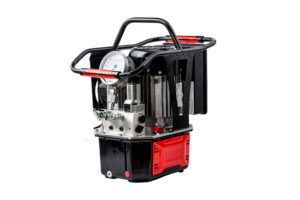
Flow Requirements: Continuous, Peak, and Combined HPU Sizing
Flow sizing follows actuator volume and required cycle time:
Flow (GPM) ≈ Cylinder Volume (in³) / (Time (sec) × 231)
For wind turbine HPUs serving both pitch and brake circuits:
- Continuous pump flow = pitch system continuous demand. Brake circuits add nothing to this figure under normal operation.
- Peak pump flow = pitch peak plus brake peak — only if both run at the same time. Controls that interlock feathering and braking in sequence let you size for the dominant peak alone.
- Pump pressure rating = the higher of the two subsystem requirements, plus a 10–20% catalog margin.
Pitch systems draw 2–8 GPM continuous at working pressure. Emergency feathering across three blades can spike to 3–10 GPM total — about 2–3× the continuous rate — for the length of the event.
Duty Cycle: The Variable That Changes Everything
A pump rated for 3,000 PSI at 10% duty behaves very differently from one running continuous. That difference shapes the whole thermal and mechanical sizing conversation.
| Duty Category | Operating Profile | Pump Implication |
|---|---|---|
| Light-duty | ≤30% of time at high pressure | Gear pumps acceptable; size near nameplate |
| Medium-duty | 30–60% at high pressure | Balanced gear or vane; add thermal margin |
| Heavy-duty | >60–80% continuous | Axial piston preferred; operate at 70–80% of max rated pressure |
A pitch system that sees peak demand only during severe storm events falls into a medium-to-light duty profile at the pump level. So the motor and cooler can be sized for continuous HP at typical duty — say, 10 GPM at 2,000–2,400 PSI. The pump itself still carries a 3,000 PSI pressure rating, and relief sits at 3,200–3,300 PSI. The reservoir and cooler absorb the thermal spike from peak events. This avoids oversizing the motor for conditions that occur only a small fraction of the operating year.
Hydraulic Pump Technology Comparison: Gear, Vane, and Piston Pumps


Three pump families dominate wind turbine hydraulic systems. Each one sits in a distinct pressure band, cost tier, and performance range. Cross those boundaries without a good reason, and you’ll hit problems — ones that appear late, under load, at the worst possible time.
Performance at a Glance
| Pump Type | Pressure Range | Efficiency | Key Trade-off |
|---|---|---|---|
| Gear | 250–300 bar | 80–90% | Lowest cost, noisiest |
| Vane | 150–200 bar | 75–85% (up to 95%) | Quiet, contamination-sensitive |
| Axial Piston | >400 bar (up to 600+) | 85–95% | Highest cost, best control |
Gear pumps are the workhorses. Meshing gears trap fluid and push it around the casing. The geometry is simple. Displacement is fixed. Contamination tolerance is high, which makes gear pumps forgiving in rough field conditions. Yes, they’re loud. For brake circuits running intermittent duty at steady pressure below 250 bar, loud and reliable beats quiet and fragile every time.
Vane pumps give up some toughness to gain smoothness. Sliding vanes inside an eccentric cam ring produce quieter operation — 65–75 dB is a common range — plus smoother flow than gear designs deliver. The real limitation: vane pumps are sensitive to contamination in a way gear pumps are not. You need strong, consistent maintenance discipline to run them well. That’s a non-negotiable requirement.
Axial piston pumps operate where the other two fall short. Above 400 bar, with variable displacement and load-sensing control, they hit mechanical efficiency at or above 92%. That efficiency gap matters. A pitch system cycles hard against shifting aerodynamic loads, and the energy savings add up fast.
How Wind Turbine OEMs Apply These Pumps
The selection pattern in production turbines follows pressure and duty logic — there’s no guesswork involved.
Pitch systems run on axial piston units. High pressure, fast response, and variable flow under shifting wind loads demand controllability and pressure margin that gear pumps can’t provide.
Brake circuits use fixed gear pumps. Duty is intermittent. Pressure stays steady. Reliability with low service overhead matters far more than precision here.
Yaw systems fall between those two. Gear pumps handle most installations just fine. Where nacelle noise budgets are tight, vane pumps earn their place.
The fixed-versus-variable displacement question applies to all three pump types. Fixed gear units make sense for constant hydraulic demand — you want rugged simplicity over efficiency tuning. Variable piston units pay off through energy savings. The payoff comes from partial-load and standby conditions, which pitch circuits see on a regular basis during normal turbine operation. That time spent at low demand is exactly where variable displacement earns back its higher upfront cost.
Hydraulic Fluid Selection and Material Compatibility
Fluid choice is where hydraulic pump selection gets precise — and where the cost of guessing shows up years later in seal failures and corroded components.
Viscosity Grade by Operating Temperature
The right ISO viscosity grade depends on the temperature range your site sees in real operation. These benchmarks follow Bosch Rexroth guidelines and DIN 51524:
- –30 to –15°C (northern or offshore cold starts): Use HVLP or HV synthetic ISO VG 15–22. Pour point must stay below –40°C. Cold-start viscosity at the pump inlet cannot exceed 1,000–1,500 cSt. Some piston units tolerate 2,000 cSt for short periods, but that’s the ceiling — not the target.
- –15 to +10°C: ISO VG 22–32 HVLP. The high viscosity index handles seasonal swings. At maximum oil temperature (60–70°C), operating viscosity must hold above 10–12 mm²/s.
- +10 to +30°C: ISO VG 32–46 HLP or HVLP. Systems running at 60–70°C bulk oil temperature tend to land on ISO VG 46, which gives 20–30 mm²/s at operating temperature — the preferred range for most axial piston pumps.
- Above +30°C or hot nacelle environments: ISO VG 46–68, synthetic ester or high-VI mineral. Continuous operation above 70°C requires fluid that holds above 15–20 mm²/s to prevent film collapse.
For offshore and northern turbines starting at –25 to –30°C, the practical benchmark is HVLP ISO VG 32 with VI ≥ 150 and pour point ≤ –40°C — or a synthetic PAO/ester ISO VG 32/46 with pour point ≤ –45°C. Keep viscosity below 800 cSt at start so filters don’t bypass. Cold viscosity climbing higher means you need more filter area and restricted cold-start flow rates. Pump case drain pre-heating or a slow-speed warm-up cycle until viscosity drops below 400 cSt is standard practice.
Fluid Classification and Base Oil Standards
DIN 51524 defines the mineral oil categories that most wind hydraulic systems specify against:
- HLP — anti-wear protection added to the base anti-corrosion/anti-oxidation package. This is the standard choice for most pitch, yaw, and brake circuits.
- HVLP — HLP with viscosity index improvers. It covers wider temperature ranges without a grade change.
- HLPD / HVLPD — detergent/dispersant additives layered on top. Higher additive loads create compatibility risks with certain plastics, elastomers, and non-ferrous metals. Filter media and seal materials need explicit qualification before use.
Most wind turbine hydraulic systems run HLP or HVLP ISO VG 32–46, either mineral or semi-synthetic. Offshore installations focused on environmental risk management shift to HEES (synthetic ester) or HEPG (polyglycol) biodegradable fluids meeting ISO 6743-4. That shift has direct consequences for every seal in the system.
Seal Material Compatibility — The Variable Most Teams Underestimate
Fluid type and seal material are a binary match. Get it right, or plan for early failure. Here’s the compatibility picture by elastomer type:
NBR (Nitrile)
NBR works well with petroleum mineral oils — HLP and HVLP. It’s the standard spec for pitch, yaw, and brake circuits running conventional mineral fluids. The problem is synthetic esters. NBR in HEES service tends to show volume swell above 15% and measurable hardness loss, particularly above 60°C. For any installation expected to run 20-plus years on ester-based fluids, NBR is the wrong choice.
FKM (Viton/Fluoroelastomer)
FKM is compatible with both mineral oils and HEES synthetic esters. Major wind OEMs specify FKM for main shaft, pitch, and yaw seals in HEES and HEPG systems — in nacelles where oil temperatures peak between 60 and 80°C. Its temperature range runs from –26°C to +204°C. FKM handles aggressive additive packages — including zinc-free ashless AW systems — without degradation.
EPDM EPDM performs well with water-glycol HFC and phosphate-ester fire-resistant fluids. It swells severely in mineral oil. That makes it a non-option for standard wind hydraulic oil systems.
Polyurethane (PU)
PU performs well with mineral oils. In HEES service, polyester-based PU (AU) degrades faster than polyether-based PU (EU). Even the better grade needs formal qualification testing before fielding. Most designs migrating from mineral to HEES shift to FKM plus PTFE backup to remove the compatibility uncertainty.
Bosch Rexroth specifics to carry into your spec:
– HL fluids are incompatible with EPDM seals
– Zinc-free and ash-free hydraulic fluids are incompatible with bronze-filled PTFE
– HLPD/HVLPD additive packages need explicit seal and filter media testing — a general DIN 51524 pass does not guarantee compatibility with every component in your circuit

Practical Pairing Reference
| Application | Fluid | Primary Seals | Notes |
|---|---|---|---|
| Pitch & yaw, standard | Mineral HLP/HVLP ISO VG 46 | NBR rod seals, NBR static O-rings | Confirm <10% volume swell in 1,000 h at 100°C per ASTM D471 |
| Offshore pitch & yaw | HEES ISO VG 46 | FKM dynamic + static; PTFE lip seals for main shafts | Avoid standard NBR and PU unless compound-rated E for HEES at 60–80°C |
Corrosion Resistance for Offshore and Salt-Spray Environments
Fluid compatibility doesn’t stop at seals — it extends to every metal component the fluid contacts. DIN 51524 requires fluids to protect steel, copper, copper alloys, and zinc. Passing that test still doesn’t confirm the fluid is safe with every alloy in your specific pump or manifold.
For offshore installations, material and coating specs follow a clear hierarchy:
Pump housings: Ductile iron or cast steel with epoxy or polyurethane external coating rated C4–C5 per ISO 12944. Exposed manifolds and fittings in splash and spray zones step up to AISI 316 or duplex 1.4462 stainless.
Shafts and rotating components: Induction-hardened chrome-plated steel works in protected environments. Where salt exposure combines with HEES fluid chemistry, HVOF carbide coatings — WC–CoCr at 100–300 µm thickness — replace hexavalent chrome. This removes both corrosion risk and regulatory compliance issues in one step.
Fasteners: A4/316 stainless or coated high-strength carbon steel with Zn-Ni or Dacromet treatment, rated for >720 hours neutral salt spray resistance. Bolt corrosion protection ties directly into hydraulic system integrity — covered in the bolt protection section below.
Internal wetted surfaces in contact with corrosive or water-based fluids: use stainless steel, electroless nickel (Ni-P at 25–50 µm), or corrosion-resistant bronzes. External marine paint systems run to 250–350 µm dry film thickness for >1,000 hours NSS performance.
One system-level caution that applies across all these selections: bronze or yellow-metal components anywhere in the circuit require zinc-free ashless AW fluids to prevent de-zincification. Zinc-based AW fluids need confirmed compatibility with bronze and brass through DIN 51524 corrosion testing — not assumption.
Environmental and Installation Constraints in Nacelle/Tower Environments
Space inside a nacelle is not a design afterthought. It shapes every equipment decision before engineering even starts.
A modern 4–6 MW onshore turbine nacelle gives you 20–40 m³ of usable volume. Offshore units in the 10–15 MW class can exceed 60–80 m³ — but rotating equipment claims most of that space. The margins around gearboxes, generators, and yaw drives are fixed. Hydraulic pump skids compete for what’s left.
Size, Weight, and Getting Equipment Through the Door
OEMs are cutting nacelle mass by 5–20% per turbine generation to reduce tower loads and logistics costs. Every kilogram of auxiliary equipment — pumps, coolers, filter assemblies — comes under pressure from that target. High power density (kW/kg) and compact footprints aren’t preferences. They’re specifications.
Physical access adds another hard constraint. Nacelle hatches measure 600–800 mm wide and 800–1,200 mm tall. Any pump skid that exceeds those dimensions must be modularized before it reaches the site. Floor mounting patterns follow 200–400 mm bolt spacing. Baseplate spans are limited to 1.5–2.0 m before they start blocking service aisles. Minimum walkway clearance around main components is ≥500–600 mm — that number determines where a hydraulic unit can actually sit.
Mounting orientation matters too. Horizontal base-mounted units are the default. They don’t eat into headroom. Vertical inline configurations work where floor space is tight, but nacelle roof curvature and crane paths often limit where you can place them. Offshore installations add another variable: tower inclination affects reservoir fluid levels and NPSH margins in ways a flat-floor installation never does.
Vibration: The Load No One Sees Coming
Tower-nacelle systems vibrate. First fore-aft and side-side structural modes fall between 0.2–0.8 Hz. Higher modes on tall towers reach 1–3 Hz. Auxiliary equipment mounted at nacelle height must not excite those frequencies — doing so accelerates fatigue damage.
Pump skids need vibration isolation pads — rubber or metal isolators tuned to cut transmission above 10–15 Hz. Per ISO 10816/ISO 20816, allowable vibration output for auxiliary rotating equipment sits at ≤4.5 mm/s RMS. Go over that figure and you don’t just shorten pump life. You add structural fatigue loads that drive up tower service intervals.
Noise Limits and What They Mean for Pump Selection
Onshore wind projects must meet 35–45 dB(A) noise limits at nearby dwellings during nighttime hours. Inside the nacelle, occupational limits cap continuous exposure at ≤85 dB(A). So auxiliary pumps need to stay below 70–75 dB(A) at 1 meter — leaving room for gearbox and generator noise on top.
Standard gear pumps running at 150–250 bar and 1,500–1,800 RPM can push >75–80 dB(A) without enclosures. Acoustic enclosures, lower-speed motors, and elastomeric mounts bring those numbers into compliance. Low-noise screw or scroll pump variants cut emissions by another 5–10 dB(A) at comparable pressure ratings — a real difference in tight nacelle acoustic budgets. Centrifugal and ECM-driven coolant pumps run below 60–65 dB(A), making them the clear choice for converter and generator cooling loops.
Temperature Extremes and Derating
Standard onshore nacelle ambient design range runs –20 to +40°C. Cold-climate packages extend that to –30 or –40°C. Enclosed offshore nacelles under high solar exposure can hit 45–50°C inside — at that point, standard IEC motors rated for 40°C ambient lose 5–15% of allowable continuous output.
The practical fix is to build in 10–20% motor power margin for nacelle pump drives that operate during low-wind, high-ambient conditions. For hydraulic systems starting below 0°C, use 1–3 kW tank or inline heaters to keep oil above +5°C. That holds viscosity in a range the pump can handle without stall torque issues. Variable frequency drives derate at 1–2% per °C above 40°C — so you either oversize by 10–20% or add localized cooling near the drive cabinet.
Lightning, Grounding, and EMC
Wind turbines attract lightning. A typical strike carries 30,000 A. Pump drives and VFDs must connect to the nacelle equipotential bonding network. Bonding resistance targets are <0.1 Ω between bonded points per IEC 61400-24. Surge protection on power lines should handle 10–20 kA impulses using Type 1 and Type 2 devices. Route cables through nacelle trays and avoid loops — loops amplify lightning-induced overvoltage. In a confined space with hydraulic lines nearby, that kind of failure is not recoverable.
Offshore Access: The Constraint That Overrides Everything Else
Offshore nacelle work happens inside strict weather windows. Crew transfer operations need significant wave height ≤1.5–2.0 m and wind speeds ≤12–15 m/s. Those windows are non-negotiable, and they’re shorter than most onshore engineers expect.
That access reality drives one clear specification preference: remote condition monitoring for nacelle-installed hydraulic pumps. Pressure, flow, vibration, and temperature data sent back to shore cuts the number of offshore service trips needed. Each avoided trip removes a weather-window dependency. For hydraulic pump selection in offshore applications, remote monitoring capability isn’t a premium option. It’s the baseline.
Monitoring, Controls, and Smart Maintenance Integration
Sensor data doesn’t lie. In a wind turbine hydraulic system, it tells you everything before the hardware does.
Five sensor types form the core monitoring stack for hydraulic pumps in pitch, yaw, and brake circuits:
- Pressure sensors (0–250 bar or 0–400 bar, depending on circuit class) detect pressure decay, leakage, and pump wear in real time
- Flow sensors catch blocked filters, cavitation, and declining pump output before small efficiency drops turn into failures
- Temperature sensors monitor reservoir and return-line oil. Alarms are set above 60°C to protect seals and oil viscosity
- Vibration sensors on pump and motor housings flag bearing wear and misalignment before damage spreads
- Contamination sensors — particle counters, water-in-oil sensors, and filter differential-pressure monitors — protect tight-tolerance valve spools from fast-track wear
All five feed a closed loop: sensor → PLC/SCADA → fault detection → CMMS work order → technician dispatch → repair data logged to asset history. That loop is what separates condition-based maintenance from guesswork.
Control Architecture and Valve Dynamics
Proportional valves adjust flow and pressure on a continuous basis. For pitch and yaw circuits, that precision cuts out hunting, overshoot, and uneven blade positioning under shifting wind loads. Pressure control valves protect accumulator-backed emergency actuation and keep braking response stable.
The pump architecture you pair with those valves has a real impact on heat output and efficiency:
| Architecture | Best For | Trade-off |
|---|---|---|
| Fixed-displacement + proportional valve | Cyclical demand, lower CAPEX | Higher heat — excess flow throttled |
| Variable-displacement + pressure-compensated control | Frequent pitch cycles, variable load | Higher upfront cost, lower thermal load |
From Alerts to Action
Fault patterns follow clear signatures. A high-pressure, low-flow reading points to a blockage or valve restriction. Rising temperature at normal pressure signals cooling degradation or oil aging. Pressure decay at standby points to a leak, accumulator loss, or seal wear.
Tune your thresholds well and link spare parts to work orders. The numbers speak for themselves. Industry benchmarks target a 10–30% reduction in unplanned downtime and 20–40% fewer emergency maintenance events after full condition monitoring is in place. For offshore hydraulic pump installations — where every service trip depends on a weather window — those aren’t soft gains. They’re the whole business case.
Hydraulic Pump Maintenance Best Practices in Wind Power Operation
Contamination kills hydraulic pumps. Over 90% of hydraulic failures trace back to dirt or water in the fluid — not component fatigue, not pressure spikes, not bad engineering. That one statistic should drive every maintenance decision you make.
Oil Change Intervals by Environment
Interval targets are not one-size-fits-all. Your turbine’s location changes everything:
- Standard onshore: First change after 2,000–3,000 hours of run-in. After that, change every 8,000–10,000 hours or 24 months — whichever comes first. Target oil cleanliness at ISO 4406 17/15/12 or better. Keep water content below 0.1%. Act at 0.2%.
- Desert/high-dust sites: Cut intervals by 30–50% — so every 4,000–6,000 hours. Middle East field contracts run oil sampling every 15–30 days. Replacement kicks in within 15 days once particle counts breach ISO 19/17/14.
- Offshore: Changes are less frequent, but monitoring is stricter. Run oil analysis every quarter — covering TAN, water, and particle count. Replace the oil once TAN rises >1.0 mg KOH/g above the new oil baseline. Full system oil changes run every 3–5 years for pitch, yaw, and brake hydraulic pumps.
Filtration Targets
Four filter positions protect the system. Each one has a clear threshold:
| Filter Location | Rating | Change Trigger |
|---|---|---|
| Return-line | 10–25 µm absolute | Δp ≥ 1.5–2.5 bar |
| Pressure-line (servo) | 3–10 µm absolute | Contamination indicator |
| Suction strainer | 100–250 µm | Every 6 weeks |
| Breather | 3–10 µm | Check every 6 weeks; replace each year |
Particle count two ISO codes over your target? Start offline filtration right away. Then check every seal and breather in the circuit.
Daily and Periodic Checks
Before you apply load, give the pump 2–5 minutes of unloaded warm-up. Cold oil does not spread lubrication the way it should. Check fluid level, scan hoses for wet spots, and confirm pressure matches your operating setpoint — 150–250 bar for pitch and yaw actuation, up to 700 bar for bolting tools.
Every six weeks: clean the pump exterior, check all connections for leaks, inspect hoses for abrasion or wire exposure, and verify breather condition. At the annual service, drain and clean the reservoir fully. Wipe internal surfaces with approved solvent, flush piping with filtered oil, and bleed air before putting the system back in service.
Temperature and Vibration Thresholds
Normal operating oil temperature for mineral oil systems runs between 40–60°C. Temperature climbing more than 10–15°C above your set baseline — or breaking 70°C — needs attention straight away. Check cooler performance, pump case-drain flow, and relief valve settings. Sudden spikes are often a sign of cavitation or internal leakage.
On noise: a high-pitched whine points to cavitation. Rattling suggests air ingress or a loose mount. Either of those sounds? Check the suction line for restrictions and confirm inlet vacuum stays within <0.3–0.5 bar. Don’t hold off until the next scheduled service.
Power Supply for Maintenance Operations
Portable electric hydraulic pumps for nacelle torque and tensioning work run on 230 V single-phase or 400–480 V three-phase at 1–3 kW. During hydraulic maintenance, the turbine goes under lock-out/tag-out — nacelle sockets lose power. Field teams bring 2–5 kVA gasoline generators to run their tools. Those generators need to deliver pure sine-wave output, with frequency within ±1 Hz and voltage within ±5–10%. For cable runs of 50–70 m up the tower, use ≥4 mm² copper cores to hold voltage drop under 5%.
Corrosion Risks Facing Wind Turbine Bolted Connections
Bolt failure in a wind turbine gives no warning. It builds through coating cracks, trapped moisture, and thread roots that lose a little more metal with every load cycle.
The numbers tell a clear story. In ring-Flange connections, clamp force drops by more than 15% within the first 100 load cycles from vibration-induced self-loosening alone — before corrosion has done anything significant. Once corrosion starts, it targets those same thread roots. Fatigue cracks begin right where the bolt is already under the most stress.
Three Environments, Three Distinct Threat Profiles
Offshore — submerged, splash, and atmospheric zones carry the highest overall risk. The splash zone is the worst of it. Cathodic protection works only on submerged bolts. Above the waterline, wet-dry cycles combine with high oxygen and salt deposits. Bare carbon steel corrodes at 0.3–0.7 mm per year under those conditions.
Two failure mechanisms dominate offshore:
- Galvanic corrosion — carbon-steel bolts coupled to stainless or CRA components will corrode first. A study of 150 riser joints across four oceans found this pattern across the board, along with hydrogen-related fractures in high-strength bolts.
- Hydrogen-induced stress cracking (HISC) — bolts with hardness above 350 HV become vulnerable under cathodic protection. DNVGL-RP-B401 sets the hard limit: keep bolt hardness at or below 350 HV. ISO 8.8 bolts meet that limit. Grade 10.9 and 12.9 bolts often do not. CP potential must stay between −0.80 V and −1.15 V (Ag/AgCl/seawater). Push beyond −1.15 V and HISC risk in high-strength bolts climbs fast.
The most exposed offshore locations are monopile–transition piece Flanges, tower–transition interfaces in the splash zone, and ring-Flange connections on floating offshore wind turbines. At these points, combined wind-wave loading and airborne salinity push corrosion-fatigue damage along a pattern tied to prevailing wind direction.
Coastal and near-shore onshore sites fall into C3–C5 corrosivity classes under EN ISO 12944-2. Even C3 — classified as medium — caused serious damage in one documented case. Internal ring-flange bolts in a tower developed widespread white rust across the shank. Red rust followed at thread roots after the zinc was consumed in those spots. Fatigue cracks with clear beach marks formed in the threaded zone. The bolts had no direct rain exposure. Condensation inside the tower did the damage.
EDX analysis on bolts from the same tower found chlorine — confirming salt contamination even in a sheltered internal location. Watch these spots: internal flange bolts near cable penetrations and doors where water pools, yaw bearing interfaces, and base-flange areas with cyclic wetting.
Inland desert sites present a different problem. Salt-driven corrosion stays near C2–C3, but two other forces take over. Blowing sand strips zinc and polymer coatings from exposed bolt heads and nuts. Steel surface temperatures swing between −10 and +50°C daily, driving thermal expansion cycles that crack coatings and open micro-gaps at interfaces. UV exposure breaks down polymer caps and sleeves over time. Then rain arrives and finds unprotected thread crevices. It runs intense wet-dry corrosion cycles in the exact spots the coating system was built to protect.
How Corrosion Turns Into a Structural Problem
The failure sequence follows the same pattern across all three environments:
Coating degradation comes first. Cyclic loading cracks hot-dip galvanized coatings. Radial cracks spread from the zinc layer into the steel. Oxygen-concentration cells and trapped electrolyte build up in those crevices. Zinc corrosion accelerates, then steel corrosion starts where the zinc runs out. In the ring-flange case above, the bolt head stayed in reasonable condition. The shank buried in the flange thickness — where airflow was restricted and moisture trapped — took the worst damage.
Thread crevices amplify the damage. The tight contact zones between nut, washer, flange face, and bolt shank cut off oxygen flow. The interior turns oxygen-poor and acidic. Cyclic loads cause fretting, which strips passive films at thread flanks and exposes fresh metal to that corrosive environment again and again.
Preload loss follows. Corrosion products expand against joint interfaces and disrupt load paths. Pits forming at thread roots raise the stress concentration factor — pit depths of just 0.1–0.3 mm can cut high-cycle fatigue life by 50–80% in bolt steels. For floating offshore wind turbine ring-flange bolts, corrosion-fatigue models show that corrosion rate and stress range together control how fast damage builds. Floating platform dynamics also push tower stress ranges high enough to accelerate deterioration well past what fixed-bottom turbines experience.
Design Choices That Limit Corrosion Damage
A few decisions at the specification stage prevent most of what the case studies above show:
- Use ISO 8.8 bolts in submerged or CP-protected zones. Keep hardness at or below 350 HV. Avoid 10.9 and 12.9 grades in those environments — or switch to CRA bolts with formal qualification testing.
- Encapsulate splash-zone and exposed flange bolts with polymer sleeves and sealed caps, or specify CRA bolts. Qualification must cover splash-zone testing and full-scale flange mechanical validation.
- Maintain CP potential within the safe window — more negative than −0.80 V for protection, but not past −1.15 V where HISC risk rises.
- Prioritize inspection at internal ring-flange connections where condensation builds up, splash-zone transition piece flanges, and any mixed-material flanges where galvanic coupling puts the full corrosion load on carbon-steel bolts.
Anti-Corrosion Material and Coating Solutions for Wind Power Bolts

Coating selection for wind turbine bolts is not an aesthetic decision — it is a structural one. The wrong system on the wrong Bolt grade burns through protection in a few seasons. That leaves steel thread roots exposed to the conditions described in the previous section.
Four coating families cover most real-world applications.
Hot-dip galvanizing (HDG) deposits 50–85 µm of zinc onto the bolt surface. At 50 µm, you get 600–1,000 hours to first red rust in neutral salt spray testing. At 80–100 µm, that extends to 1,000–1,500 hours. HDG works well for ISO 8.8 and 10.9 bolts on tower flanges and base plates where volume is high and cost pressure is real. The limitations matter though:
- Coating thickness disrupts tight thread tolerances
- Hydrogen embrittlement risk makes HDG unsuitable for bolts above 1,000 MPa tensile strength
Zinc-flake systems — Dacromet, Geomet, Doerken variants — solve that problem. At just 8–12 µm total thickness, they cause no thread interference and carry no hydrogen embrittlement risk. Salt spray resistance reaches 1,500 hours on well-applied wind stud systems. Dacromet was added as the approved metallic coating for ASTM A490 high-strength structural bolts after dedicated hydrogen embrittlement testing. For 10.9–12.9 tower flange bolts and blade root studs, zinc-flake is the current industry standard.
For foundation anchor bolts, petrolatum tape systems are a strong choice. Over 900 anchor bolts at a California wind farm use them. They provide sealed encapsulation that tolerates retensioning without removal and reapplication damage. Polymer coatings like moisture-cured urethane have shown near-zero chipping or flaking through repeated tensioning cycles in field conditions. Both outperform the legacy plastic cap-and-grease approach. That older method traps water behind the cap and hides active corrosion during inspections.
Practical Selection by Application
| Application | Preferred System | Notes |
|---|---|---|
| Onshore tower flange (8.8/10.9) | HDG or mechanical zinc, 40–70 µm | Expect >20-year inland life; 10–15 years coastal with maintenance |
| High-strength structural bolts (A490/10.9–12.9) | Zinc-flake, 8–12 µm | Validated to ≥600–1,500 h NSS |
| Foundation anchor bolts above concrete | Petrolatum tape + outer wrap, or polymer coating | Must tolerate retensioning; avoid sealed plastic caps |
| Offshore severe marine | HDG 80–100 µm or duplex zinc-flake + topcoat | Pair with CP system within −0.80 to −1.15 V window |
One last point ties back to hydraulic pump calibration. Zinc-flake coatings carry friction coefficients in the range of 0.12–0.16. HDG runs 0.18–0.22 unlubricated. So the gap between the two is real. Your tensioning procedure was built around HDG bolts. Switch to zinc-flake without recalibrating torque-tension relationships, and you over-tension. That pressure shift feeds back into how your hydraulic pump delivers load. The coating system and the pump calibration are not independent variables.
Lubrication, Sealing, and Anti-Seize Application on Wind Turbine Bolts
A torque wrench doesn’t lie — but it makes one assumption that isn’t always true: every bolt in the joint shares the same friction condition.
Change that friction and you change the clamp load. The torque number stays the same on paper. The preload does not.
That’s the real problem with anti-seize compounds, thread pastes, and sealants. No clear procedure means trouble. Used the right way, they protect threaded fasteners from seizure, corrosion, and the cold-welding that turns a routine blade root inspection into a full-day extraction job. Used without a consistent approach — mixing lubricated and dry contact surfaces in the same joint — they scatter clamp load across bolts that are supposed to share it in equal measure.
Approved Products and What They Do
Four product families cover most wind turbine bolting applications:
Molykote pastes show up most often in wind-specific technical guidance. The goal is a low, steady coefficient of friction across the thread flank and bearing surface. Steady friction is what makes torque tables reliable. DGE Europe references them for threaded wind turbine bolts — covering corrosion resistance, seizure prevention, and controlled tensioning.
Loctite C5-A is copper-based, rated to 982°C, and works with steel, stainless, brass, cast iron, and non-metallic gasketing materials. It handles corrosion and galling prevention on most structural fasteners.
Loctite Silver Grade uses a graphite-and-metallic-flake formula rated up to 871°C. The heavy petroleum carrier holds up well in tight, hard-to-reach spots where reapplication isn’t practical.
SAF-T-EZE carries the highest temperature rating in this group — 1,425°C. It also makes a clear, quantified claim: apply it, and you need at least 20% less torque to reach the same prescribed tension as dry parts. That’s not a loose recommendation. It’s a direct warning — don’t carry dry torque tables over to lubricated installations without recalculating first.
Chesterton anti-seize compounds are built around steady tension, not just seizure prevention. You also get H1 food-grade versions for applications where incidental contact is a concern.
For fasteners in submerged or direct salt-water exposure — monopile base flanges, for example — marine-grade anti-seize is the right call. It handles galvanic corrosion risk and resists fresh and salt water washout where standard pastes fail.
Where Each Product Type Belongs
Application zones follow the function of the fastener, not just its location:
- Threaded load-bearing fasteners — blade root studs, tower flange bolts, nacelle mounting bolts — take anti-seize paste only if the OEM torque procedure is written for lubricated assembly. Confirm that first.
- Splines, powertrain mounting bolts, and exposed fasteners at risk of seizure use anti-seize to guard against cold-welding and allow future removal without damage.
- Gearboxes, hydraulic fittings, and flanges take anaerobic thread sealants — not anti-seize. The goal there is blocking fluid and moisture ingress, not controlling friction.
- Generator housings, service doors, cable penetrations, and nacelle enclosures use moisture-curing sealants to stop ingress. These are sealing interfaces, not clamp-load interfaces.
The boundary is clear: anti-seize on friction interfaces, sealant on sealing interfaces, protective grease on external exposure points outside the load path. Mix those categories and problems follow — not right away, but after 50,000 load cycles, once preload has shifted in ways nobody planned for.
The Friction Consistency Rule
One rule overrides everything else here: keep the friction condition the same across every bolt in the joint.
The first bolt goes in with paste on the thread and under the head? All of them do. The three contact zones — thread flank, under-head bearing surface, nut face — get the same treatment on every fastener. No exceptions.
Friction variation across bolts leads to clamp load scatter. Some bolts end up carrying more of the joint load than the design intended. Those bolts wear out faster. In a ring-flange connection already dealing with cyclic loading from wind and wave action, that scatter is the kind of problem that starts crack initiation at thread roots.
Hydraulic Tool Calibration — The Link Between Both Topics
Hydraulic torque and tensioning tools are built around a known friction state. That assumption sits inside the pressure calibration. Switch to anti-seize mid-project without updating the procedure, and the pump puts out the same pressure as before — but the bolt now sees a different clamp load on the other end.
This is where lubrication and calibration meet at the workface. The hydraulic pump pressure setting is meaningful only if the friction coefficient it was calibrated against matches what’s on the bolt. SAF-T-EZE’s 20% torque reduction figure is a real number. Run it without recalibration, and structural bolts end up over-tensioned relative to design intent — quietly, on every joint in the installation.
Re-torquing carries the same risk. A bolt tightened dry on first installation gets re-torqued dry. Switching to a lubricated re-torque on the same fastener shifts the clamp load in a direction the original calculation never covered.
Match the lubricant condition to the approved procedure. Check it before the hydraulic tool goes on the nut. That check costs nothing. Getting it wrong costs a great deal more.
Scheduled Inspection and Re-Protection Maintenance Program for Bolts
Bolts don’t announce their condition. They sit under load, inside flanges, behind access panels. The only way to know what’s happening is to look, measure, and record on a fixed schedule.
Inspection Intervals That Match Real Operating Conditions
Interval length depends on what the bolt does and where it lives:
- High-vibration equipment (hydraulic breaker through-bolts): run a visual check every day for loose nuts and visible cracks. Every 50–100 operating hours, disassemble, clean, and measure diameter against the new-bolt specification. Replace when measured diameter drops by ≥1–2%. Re-lube and re-torque before reinstalling.
- Structural anchor bolts: check torque on accessible fasteners every week. Inspect threads and bearing surfaces each month. Run a tension audit once a year — more often in marine or C4–C5 environments.
One useful calibration rule: repeated inspections find bolts in near-new condition? Extend the interval by 25–50%. Near-critical findings keep appearing? Cut it by the same margin.
Visual Corrosion Rating — What Stays, What Goes
Use a five-class scale adapted from ISO 9223 practice:
| Class | Condition | Action |
|---|---|---|
| 0–1 | No rust or <5% surface staining | Clean and re-protect; keep in service |
| 2 | 5–20% rust coverage; shallow pits <0.1–0.2 mm; threads intact | Re-coat after cleaning if no section loss |
| 3 | 20–50% coverage; pitting 0.2–0.5 mm; partial thread rounding | Engineering review required; replace in primary connections |
| 4 | >50% coverage; pitting >0.5 mm; visible thread deformation | Mandatory replacement — re-coating alone is not acceptable |
For seismic, lifting, or pressure-boundary connections, replace at the first Class 2–3 finding. Don’t attempt re-protection on these.
Coating Thickness Checks
Hot-dip galvanized bolts arrive with 45–85 µm of zinc. The re-coating threshold is ≤40 µm or ≤50% of the original measurement — use whichever value is higher. Measure with a magnetic dry-film thickness gauge. Take 3–5 readings per bolt group and use the mean value.
Any localized reading that shows exposed base steel needs coating repair right away. Don’t wait for the next scheduled inspection.
Torque Audits and Tension Verification
Installed bolts need to retain 70–110% of specified installation torque on re-check. A reading below 70% means re-torque the bolt and look into embedment loss or relaxation. Use a calibrated torque wrench and recalibrate it every 12 months or 5,000 cycles.
For large-diameter flange bolts, torque alone doesn’t give you the full picture. Use these additional checks:
- Ultrasonic elongation measurement: record the baseline length at installation. Check it at set intervals against the elongation that matches 70–90% of proof load.
- Direct tension indicators: confirm the feeler-gauge gap stays at or below the maximum allowed for the required tension.
- Turn-of-nut verification: mark the nut position. Confirm no unintended rotation has occurred since the last inspection.
Field Re-Protection Procedures
Surface preparation comes before any coating work. Remove loose rust and failed coating by hand wire brushing or needle scaling to ISO 8501-1 St 2–St 3. Degrease with mineral spirits or alkaline cleaner.
Pitting that causes section loss above 10% of nominal diameter needs an engineering review. Re-coating alone is not enough in that case.
Re-coating specifications for outdoor environments:
- Zinc-rich epoxy or zinc silicate: 60–80 µm per coat, two coats for a total of 120–160 µm in C3–C4 service. Touch-dry in 30–90 minutes at 20°C. Return to non-immersed service after 8–24 hours.
- Polyurethane or polysiloxane topcoat over zinc in C4–C5 environments: 50–75 µm. Handle after 4–8 hours; full cure takes 5–7 days.
Re-greasing follows re-coating. Put a thin, even film of anti-seize or corrosion-inhibiting grease on threads and under-head bearing surfaces. For stainless A193 B8 bolts, use nickel-based or molybdenum-disulfide anti-seize to stop galling. In high-contamination zones, re-grease every 3–6 months or at each major inspection.
Changing the lubricant type from what the original torque procedure used? Recalibrate the nut factor before re-tensioning. The friction shift feeds straight into hydraulic pump pressure requirements at the tool.

Replace vs. Re-Coat: The Decision Criteria
Section loss drives the call:
- ≤5% of nominal diameter: clean and re-coat
- 5–10% loss: get an engineering assessment; structural bolts go on the replacement schedule for the next outage
- >10% loss or visible necking: replace right away, no exceptions
Thread condition adds a separate filter. Bolts with rolled-over flanks, bolts that can’t engage a nut to full grip length, or any bolt with a detectable crack — found by visual, dye-penetrant, or magnetic-particle inspection — come out right away. There is no repair path for a cracked fastener.
Record-Keeping
Keep a log per bolt group. Record the inspection date, inspector name, corrosion class found, torque readings, coating thickness if measured, and action taken. Feed that data into your CMMS.
Any bolt group that hits Class 2 corrosion or shows torque loss above 30% drops to a shorter re-inspection interval. The system enforces this — it doesn’t rely on individual judgment at the workface.
Conclusion
The hydraulic pump inside your nacelle isn’t just a component. It’s the heartbeat of pitch control, braking, and everything that keeps a multi-megawatt turbine responding to the wind. Pick the wrong pump, and no amount of smart monitoring will prevent premature failure. Get the bolt corrosion strategy wrong, and that same turbine becomes a liability sitting 80 meters above ground.
The message throughout this guide stays the same. Precision in selection, discipline in protection, and consistency in maintenance aren’t optional upgrades. They’re the baseline for wind assets that hold up across a 20-year service life.
So here’s your next step: audit your current hydraulic pump specs against actual site pressure and flow demands. Then cross-reference your bolt protection protocols with the inspection intervals outlined here. The turbines that deliver the strongest ROI aren’t the newest ones. They’re the best-maintained ones.
