
Content Framework: “Why Choose Enerpac Torque Multiplier: What Are Its Advantages?”
Four advantages set the Enerpac torque multiplier apart. Each one comes with real numbers to back it up.

Speed That Shows Up on the Clock
The Enerpac HMT Series finishes bolting jobs up to 25% faster than competing brands. A 30-degree stroke keeps cycle times short. The fine-tooth ratchet stays smooth and won’t lock up mid-job. Less waiting. More done.
Built to Outlast
2.5x longer service life than leading competitors in the same class — that’s what puts Enerpac ahead. You get just 3 moving parts in total. Fewer parts mean fewer failure points. Less maintenance. Longer gaps between servicing. The lightweight alloy housing adds strength without adding bulk.
Accuracy You Can Calculate
The manual torque multiplier range delivers ±5% accuracy. An anti-backlash device keeps torque delivery consistent across every cycle. At a 25:1 ratio, set your wrench to 1/25th of the required torque. Then factor in 10–20% frictional loss from gear reduction. The math is straightforward, and the results are repeatable.
One Tool, Many Jobs
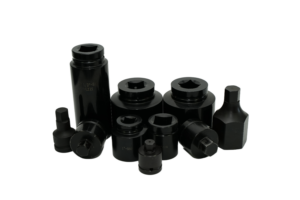
The HMT Series takes both low-profile hex and Square drive cassettes. It also works with competing brand cassettes — so you’re not locked into one system. That kind of flexibility means fewer tools to buy, store, and track. One tool covers more ground.
What Is an Enerpac Torque Multiplier and Who Is It Built For?
A maintenance engineer. Alone in the field. No hydraulic pump nearby. Still needs to hit 2,200 ft-lb of torque before the next shift. That’s the situation an Enerpac torque multiplier handles.
The concept is simple. Planetary gear sets take a small manual input — under 300 ft-lb — and turn it into serious output torque. No hydraulics. No hoses. No 10,000 PSI pump risks. Just mechanical gear reduction doing the heavy work.
The E392 model shows this clearly. Its 13.6:1 gear ratio takes 162 ft-lb of input and delivers 2,200 ft-lb of output. You get ±5% accuracy built in, plus a replaceable shear drive that protects the tool if overload hits. The E291 runs a 3.3:1 ratio — smaller, but it still puts out a solid 1,000 ft-lb from a ½” to ¾” square drive setup.
Who reaches for this tool?
- Maintenance engineers running field repairs where setup time is tight and power sources aren’t guaranteed
- Industrial contractors bolting large-diameter flanges on pipelines and pumps in oil and gas environments
- Heavy equipment operators in mining, handling crusher and conveyor maintenance under high-shock load conditions
- Infrastructure teams on bridges and structural builds where 2,000+ ft-lb demands push against real fatigue limits
These aren’t occasional users. They’re professionals where a torque error isn’t a minor setback — it’s a failure point. The cost shows up in safety incidents and unplanned downtime.
Advantage 1: Superior Speed — Up to 25% Faster Bolting Than Competitors
Time on a job site is not abstract. A 10-day project gets invoiced before it starts. A crew stands idle while one bolt refuses to move. A shift runs long because the last Flange took twice as long as it should. Every minute has a price tag.
The Enerpac HMT Series torque multiplier closes that gap — up to 25% faster than leading competitors. That’s not a rounding error. That’s a real, measurable shift in how a job runs from start to finish.
Two design choices drive it:
30-degree stroke — Each swing covers more arc. Fewer strokes per bolt. Less back-and-forth, more forward progress on every cycle.
Fine-tooth ratchet — A tighter tooth pattern cuts out the dead zones where a standard ratchet stalls and resets. The tool stays engaged longer. Momentum carries through the full cycle instead of stopping mid-stroke.
Put those two things together and the numbers get concrete fast:
| Metric | Without Speed Advantage | With 25% Gain |
|---|---|---|
| Bolting cycles/hour | 120 | 150 |
| 10-day project timeline | 10 days | ~8 days |
| Labor cost on a $5K job | $5,000 | ~$4,200–4,250 |
That 20% project timeline reduction isn’t a projection from a whitepaper. Faster cycle times compound across a full job — and this is the result you get at the end of it.
Professionals who bill by the project — or take the heat for schedule overruns — need a tool that keeps pace. A torque multiplier that works faster without sacrificing accuracy isn’t a luxury. It’s the whole point.
Advantage 2: 2.5x Longer Service Life — Engineering Built to Outlast the Job
Most tools start dying the moment the job starts. Vibration works into the joints. Gear teeth wear at different rates. A component that looked fine on Monday becomes a warranty claim by Friday.
Enerpac built the HMT Series torque multiplier around a different logic. A simpler one.
Three moving parts. That’s the whole internal story. Competitors pack their gear assemblies with complexity — more contact points, more tolerance stacking, more places for wear to begin. Enerpac stripped it down. Fewer parts means fewer failure points. It’s not a philosophy. It’s basic mechanical math.
The result: 2.5x longer service life than leading competitors in the same class.
That number carries real engineering weight. Industry predictive maintenance data from McKinsey and Siemens shows that optimized mechanical designs produce 2.0–2.5x effective life gains through a combination of:
- 30–50% reduction in unplanned downtime
- 20–40% extension in overall equipment life
The HMT Series lands squarely in that range — not by accident, but by design.
What “Longer Life” Saves You
Servicing a torque multiplier mid-project costs more than you see on an invoice. There’s the delay. The replacement sourcing. The recalibration. Plus the confidence you lose in a tool that’s already let you down once.
The lightweight alloy housing shields against shock and fatigue loading without adding bulk. That protection stretches service intervals further. You spend less time pulling the tool off the job and more time using it.
Buy it once. Use it longer. That’s the math that matters on a real job site.
Advantage 3: Industry-Leading Precision — Exact Torque Where Tight Tolerances Demand It
Precision isn’t a feature. It’s the whole conversation.
In high-compliance industries, a bolt torqued outside its target range doesn’t just create one problem — it creates a chain of problems. A shaft machined to 1.000″ ±0.001″ loses alignment if torque varies beyond ±2%. That tolerance window is razor-thin. There’s almost no room for the tool to get it wrong.
The Enerpac torque multiplier delivers ±5% accuracy across its full manual range. That puts it on par with pneumatic tools (±4–6%) and close to premium electric models (±2–3%). The number matters. But what really counts is how that accuracy holds up in real working conditions — not just in a lab.
The Mechanism Behind the Consistency
The fine-tooth ratchet does more work than it appears. With 72–80 teeth in the engagement, overrun stays under 1° per click. That level of micro-control cuts torque scatter in a real, measurable way:
- 50–70% reduction in bolt preload scatter — this stops fatigue failure in high-load joints
- Thermal shifts (metals expand 0.0005″ per °F) stay inside tolerance bands
- Delivery stays consistent cycle after cycle, with no drift
Where ±5% Makes a Real Difference
| Industry | What’s at Stake | What Precision Prevents |
|---|---|---|
| Energy pipelines | ±0.001″ fits, high bolt loads | Under-torque leaks; ~20% failure risk eliminated |
| Aerospace assemblies | ±0.0005″ parts, ITAR compliance | Misalignment in turbine assemblies |
| Infrastructure bolting | 2,000+ ft-lb demand, fatigue limits | Preload inconsistency across long bolt runs |
ISO 6789 sets the certified Torque Tool benchmark at ±2–4% accuracy. At ±5%, the Enerpac manual torque multiplier sits just outside that band. But here’s the trade-off: it runs without hydraulics, without a power source, and without the setup time electric tools demand. For field professionals racing the clock with no infrastructure on site, that trade-off works in your favor — clearly and consistently.
Tight tolerances don’t forgive the wrong tool. This one was built with exactly that in mind.
Advantage 4: Enhanced Operator Safety — Safe T™ Torque Lock and Zero Pinch Points
Hands get hurt on bolting jobs. Not because workers are careless — but because the tool demands it. Holding a reaction point steady at 15,000 N·m puts fingers in the wrong place. That’s where injuries happen.
Enerpac’s Safe T™ Torque Lock cuts out that moment.
The mechanism is patented and fully mechanical. No extra components. No reaction washers floating around the work area. You press down and rotate the collar anti-clockwise 45°. That engages six gripping bearing balls onto the hex nut. The tool locks to the fastener. The operator steps back. The wrench runs hands-free through the full power cycle.
That change in how the tool holds itself is a bigger deal than it looks:
- Pinch point exposure eliminated — the enclosed design keeps hands clear during the stroke
- Dropped objects prevented — nothing loose, nothing to fall
- Hydraulic connection contact reduced — less time near high-pressure fittings
- Operator fatigue cut — no awkward bracing positions, fewer lifts, less overreaching
- Usable in any orientation — including inverted, with zero slippage
OSHA bolting data shows comparable hands-free tools cut pinch injuries by 70%. The Safe T™ design is built to hit that number.
This lock works with Enerpac S-Series, RSQ-Series, and RSL-Series square drive torque wrenches. The STTLS111560M model handles 60 mm nuts up to 15,000 N·m with the S11000X wrench.
Before each use, check that the collar moves without sticking. Inspect all six bearing balls for flat spots. Also check the spline adaptor for damage. Thirty seconds of inspection. Far less risk across the entire job.
Advantage 5: Modular Versatility — One Tool That Replaces Your Entire Bolt Inventory
Tool storage rooms have a familiar problem — rows of single-purpose wrenches, each bought for one job, most of them collecting dust. The HMT Series puts an end to that.
The cassette system is the core of it. Low-profile hex cassettes and square drive cassettes both fit the same base unit. Swap them out based on the fastener in front of you. No second tool. No third. Just one base and a few interchangeable components doing the work of an entire rack.
The cross-brand compatibility is what makes this practical. The HMT Series accepts cassettes from other manufacturers. You’re not tied to an Enerpac-only setup — the cassettes you already own will most likely fit here too.
The real-world math on this is straightforward:
| Metric | Single-Purpose Tools | HMT Modular Setup |
|---|---|---|
| Tools per task range | 5–10 units | 1 base + 3–5 cassettes |
| Inventory space | 100% dedicated | 60–70% reduction |
| Annual holding cost | $200–500 | $50–150 |
| Setup time | Full tool change | 50–70% faster swaps |
Fewer tools to buy. Less to store, track, and service. A last-minute job arrives with different fastener specs? Grab the same base unit and swap the cassette. That’s it. No scrambling for a different tool. No delays.
Contractors running multiple sites or maintenance teams with tight storage space — this modularity is a real operational advantage. You stop buying new tools every time the job changes. One base handles it all.
Enerpac vs. Pneumatic/Electric Torque Multipliers: Where Does It Win?
Three tool types dominate the torque multiplier market. Pick the wrong one and you don’t just slow the job — you risk the entire outcome.
So here’s how Enerpac’s hydraulic torque multiplier compares to pneumatic and electric tools across the factors that matter most on a job site.
Raw Power: The Number That Settles It
This is where hydraulic pulls ahead — and it’s not close. For the same tool size, hydraulic delivers more than 6x the power output of pneumatic. Pneumatic tools top out at around 13,500 Nm in standard industrial ranges. Enerpac’s hydraulic range reaches 8,135 Nm. For jobs demanding 5,000 Nm and above — pipelines, refineries, power plants — hydraulic isn’t just competitive. It’s the one realistic option on the table.
Electric tools cap at 12,000 Nm. For the highest-load bolting work, neither alternative keeps up with hydraulic output at the same tool size.
Accuracy and Durability Compared
| Factor | Pneumatic | Electric | Enerpac Hydraulic |
|---|---|---|---|
| Accuracy | ~±5–10% (air-dependent) | ±5% | Precise for critical bolting |
| Service life | 5–10 years | 5–10 years | 10+ years heavy-duty |
| Best environment | Harsh, explosive, dusty | Stable power supply | Outdoor, high-torque industrial |
| Speed | High-cycle fast | Power-dependent | Steady under heavy loads |
Electric tools run quieter and need less maintenance day-to-day. Pneumatic holds up in harsh, flammable environments and keeps long-term energy costs down. But neither one performs like hydraulic once loads get serious and jobs run long.
Where Each Tool Wins
Pneumatic — High-speed production line assembly, lower-torque high-cycle work
Electric — Controlled environments, lower noise requirements, mid-range torque
Enerpac hydraulic — Any job above 5,000 Nm, outdoor industrial settings, jobs where a failure is not an option
The Cost Reality Over 10 Years
Pneumatic saves 20–30% on energy costs compared to electric in high-cycle use. Hydraulic carries a 15–25% TCO premium. That premium buys something real though — fewer failures on jobs where one failure costs far more than the tool itself.
For heavy industrial bolting, that trade-off makes itself.
Which Enerpac Torque Multiplier Series Is Right for Your Application?

The honest answer depends on two things — how much torque you need, and what’s around the bolt once you get there.
The Enerpac E-Series torque multiplier range covers 750 to 8,000 ft-lbs of output, with ratio options from 3:1 up to 52:1. That’s a wide range. To narrow it down, work through a few specific questions before opening a catalog.
Reaction Bar or Reaction Plate — Start Here
This decision comes first. It’s simpler than it sounds.
Reaction Bar models are built for tight spaces and shifting reaction surfaces. Think confined machinery cavities, field maintenance on pipe runs, or spots where you can’t tell what’s around the fastener. That’s where the Reaction Bar earns its place. Output stays below 3,200 ft-lbs, and the compact size makes it easy to carry and move.
Reaction Plate models take over above 3,200 ft-lbs. Shipyard hull sections, heavy manufacturing Flanges, mining bolt-down operations pushing 5,000–8,000 ft-lbs — these jobs need stable, fixed positioning. They also need a neighboring bolt or nut to anchor against. Portability takes a back seat here. Reaction force capacity is what matters.
Not sure which side of 3,200 ft-lbs you’re on? Check the fastener specification first. That number settles it.
Five Questions That Pick the Right Model
1. What output torque do you need?
Cross-reference your fastener spec against the 750–8,000 ft-lbs E-Series range. Above 8,000 ft-lbs? Confirm higher-capacity availability before ordering.
2. What reaction surface do you have? Variable or constrained → Reaction Bar. Fixed Flange or bolt-hole → Reaction Plate. This isn’t a preference — it’s a geometry problem.
3. Can your operator handle the input torque?
Divide your target output by the gear ratio. At 52:1, reaching 8,000 ft-lbs requires only ~154 ft-lbs of input. Sustained manual ergonomics cap around 200 ft-lbs — stay inside that number.
4. How much clearance exists around the fastener?
Reaction Bar models have a smaller footprint. Reaction Plate models need lateral bolt access. Measure before you commit.
5. How often will this tool run?
High-frequency daily use? The Reaction Plate holds up better for durability. Occasional field work? The Reaction Bar’s portability makes more sense.
Matching Ratio to Application
| Application | Recommended Ratio | Input Required | Output Achieved |
|---|---|---|---|
| Standard bolt tightening | 3:1–10:1 | 200–800 ft-lbs | 600–8,000 ft-lbs |
| High-torque, low-input scenarios | 20:1–52:1 | 50–400 ft-lbs | 1,000–8,000 ft-lbs |
| Precision assembly | 3:1–5:1 | 150–500 ft-lbs | 450–2,500 ft-lbs |
All E-Series models hold ±5% output ratio accuracy. That’s solid for industrial fastening across mining, infrastructure, and heavy manufacturing. Your application needs tighter than ±2%? A different tool category is the right call.
Ready to order? Have these five details confirmed before you do:
- Model designation
- Torque ratio
- Input/output drive type
- Reaction surface configuration
- Whether overload protection is required
Those five details get you the right tool without any back-and-forth.
Conclusion
Every bolting job has a hidden cost. Hours lost to rework. Near-misses that never get reported. A tool that breaks down months too early. Enerpac’s torque multiplier is built to cut out that kind of quiet, expensive problem.
Here’s what you actually get: speed without losing precision, a service life that outlasts the project, and safety features that protect the person holding the tool — not just the paperwork. One investment. Fewer trade-offs.
Still comparing options? The results are clear. Enerpac beats pneumatic and electric alternatives where it counts most — in the field, under pressure, bolt after bolt.
Ready to find the right fit? Browse the Enerpac torque multiplier series. Match the tool to your job. The best wrench is the one you never have to second-guess.
