
What A Hydraulic Torque Wrench Actually Does (Core Function Clarification)
Cut through the jargon, and a hydraulic torque wrench does one specific thing: it applies a controlled, measured amount of rotational force to a fastener until it hits a precise target — then stops. Not “tight enough.” Not “as hard as you can.” A number. A verified, repeatable number.
That’s the whole point.

Controlled Force, Not Brute Force
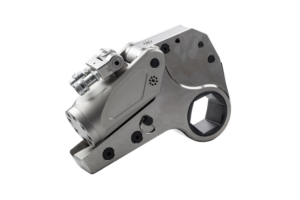
The mechanism is simple. hydraulic oil pressure from a separate pump drives an internal piston. That piston moves a ratchet or hex ring in small, steady cycles. The fastener turns in small steps until the pressure target is met. At that point, the wrench stops on its own.
Here’s what sets it apart from other tools:
vs. manual wrenching — output force doesn’t depend on operator strength. You set it by matching pump pressure to a torque chart
vs. impact wrenching — no hammering blows. The wrench moves the fastener through a controlled cycle to a specific value
Loosening mode — the same hydraulic system runs in reverse. Pump pressure goes up to 10,000 PSI for de-torquing
The wrench head stays compact because the pump — the power source — sits separate from it. In tight spaces, that’s a big deal.
The main goal is preload control. The joint reaches a set clamping force. You can measure it. You can verify it. That’s what separates a fastener that holds from one that fails.
How Hydraulic Torque Wrenches Tighten Bolts — And Why It Matters
The numbers say it all. A hydraulic torque wrench hits ±3% accuracy. A calibrated click-type manual wrench? ±4–6% — and that’s on a good day with a fresh calibration. An impact gun with no torque control? You’re at ±10–30% variability. Air pressure, friction, operator fatigue — all of it affects the result.
That gap isn’t a minor detail. It’s the difference between a joint that holds and one that fails.
The Mechanism, Step by Step
Here’s what happens inside the wrench the moment you pull that trigger:
- The hydraulic pump sends pressurized oil — up to 700 bar (10,000 psi) — through the hoses to the wrench head
- That pressure drives a piston through a cylinder, creating linear force
- An internal ratchet takes each piston stroke and turns it into small, incremental rotation of the drive connected to the nut
- The reaction arm braces against a nearby surface. It absorbs the opposing force, so 100% of output goes into the fastener
- The pump cycles — advance, retract, advance. It keeps going until the nut stops turning and pressure peaks at stall. That peak signals target torque is reached
No guessing. No “feels about right.” A number, confirmed by pressure.
Why Multi-Pass Tightening Matters
Take a real Flange job requiring 1,800 Nm. The correct procedure never jumps straight to full torque:
Pass 1: 600 Nm (one-third), star pattern across all bolts
Pass 2: 1,200 Nm (two-thirds), star pattern repeated
Pass 3: 1,800 Nm, full torque, star pattern
Final pass: 1,800 Nm, clockwise around the flange to equalize relaxation
This sequence has one purpose: even load distribution. Skip it, and you get high-load bolts sitting next to low-load bolts. That leads to gasket tilt and localized overstress. In high-pressure service, the end result is leaks, bolt fatigue, or full joint blowout.
With proper hydraulic procedure, bolt load scatter across a Flange stays within ±10–15% of target preload. Use an uncalibrated impact gun, and that scatter blows out to ±30–50%. Engineers in oil and gas, petrochemical, and power generation can’t work with numbers like that.
That’s why the tool exists. Not just to tighten bolts — but to tighten them the same way, every time, to a number you can verify.
Can A Hydraulic Torque Wrench Loosen Bolts? (The De-Torquing Function)
Loosening bolts is a real, documented function of a hydraulic torque wrench — not a workaround, not a rare use case. Vendors list it as standard. Maintenance crews use it on Flanges, large-diameter studs, and joints that have been under high preload for years.
The correct term is de-torquing or breakout. The wrench applies reverse torque in a controlled stroke. Same hydraulic system, same pump — just the opposite direction. Once the fastener breaks free, most operators switch to an impact wrench to finish the job. The Hydraulic Wrench handles the hard part.
Reversing Direction: Two Methods
How you flip the direction depends on the tool type:
Square drive models — swap the square drive to the opposite side of the wrench body
Low-clearance / cassette models — reposition or flip the wrench on the joint so the force acts in reverse
Neither method is difficult. Both do require a solid reaction surface that can take the load coming back at it.
The Number You Need to Know
Light rust alone can push breakaway torque to 3× the original installation torque. A fastener installed at 2,000 ft-lb may need 6,000 ft-lb to break free. That’s not a manual breaker bar situation.
Hydraulic breakout handles this well. The pump-driven system delivers repeatable, controlled force. No sudden shock loading. No operator strain. No guessing whether the next pull will crack it loose.
Where it earns its place: corroded joints, heavy preload studs, large-diameter fasteners in confined spaces. Manual tools struggle in these conditions. A hydraulic torque wrench doesn’t.
What Hydraulic Torque Wrenches Are NOT Designed For (Critical Limitations)
There’s a version of this tool that lives in people’s heads — the one that handles anything you throw at it. That version doesn’t exist.
A hydraulic torque wrench is a precision instrument with hard limits. Push past those limits and you don’t just get bad results. You get a damaged tool, a failed calibration, and a real injury risk. Here’s where those limits actually sit.
Seized and Heavily Corroded Fasteners
This is the big one. A hydraulic torque wrench runs on a precision-calibrated ratcheting system and a hydraulic drive built to deliver controlled torque within a set range. Manufacturers are clear: “Applying tension that exceeds the calibrated range is an absolute no — it leads to instrument malfunction and puts people at risk of accidents.”
That’s not fine print. It’s the core design constraint.
In heavy industry, a badly corroded fastener can demand breakaway torque two to three times higher than the original installation torque. A bolt installed at 2,000 ft-lb may need 6,000 ft-lb to move. Forcing a hydraulic torque wrench through that load causes real, specific damage:
Internal ratchet teeth and pawls distort or crack — calibration drifts, and repeatability is gone
Hydraulic over-pressure blows out seals, hoses, and the pump itself
The tool needs immediate recalibration — and may be past saving
The right approach is a staged handoff:
- Soak the fastener with penetrating oil. Give it dwell time before reaching for any torque tool
- Use a breaker bar, impact wrench, or slugging wrench to get initial movement — these tools are built for shock loading and high breakaway force
- Once the fastener turns freely, bring in the hydraulic torque wrench to land the accurate final torque value
Impact Loading and “Cheater Bar” Misuse
A hydraulic torque wrench builds torque through smooth, controlled hydraulic pressure. It is a non-impact tool by design. Striking the housing, hammering the reaction arm, or slipping a cheater bar over the handle all break that design intent. Manufacturer guidance prohibits each one, without exception.
Cheater bars don’t just damage the wrench. They corrupt the torque output too — you get false readings while the precision mechanism you paid for gets destroyed from the inside.
High-Cycle Factory Applications
One more limit worth knowing: Hydraulic Torque Wrenches are not built for continuous, high-cycle production environments. For that kind of workload, pneumatic torque wrenches are the better fit. hydraulic tools belong on large, critical fasteners in field conditions — not running hundreds of bolts down an assembly line.
The pattern across all of these is the same: a hydraulic torque wrench does its job well when the work demands controlled, verified, repeatable force. Ask it to be something else — a breaker, a production tool, a blunt instrument — and it will fail. Sometimes on its own terms. Sometimes on yours.
Industries and Applications Where Hydraulic Torque Wrenches Are Indispensable

Some tools belong in specific industries for one reason: the cost of a mistake is too high. The hydraulic torque wrench is that tool. Here’s where it earns its place.
Oil & Gas: Pipeline Flanges, Wellheads, and Drilling Equipment
The numbers are not small. General-purpose hydraulic wrenches start around 100 ft·lb and scale up to 120,000 ft·lb for the largest subsea and drilling jobs. On a 24–48-inch class 600–900 pipeline flange, each bolt torque target falls between 2,000–10,000 ft·lb. No manual tool reaches that range safely.
The stakes match the scale:
- Wellhead systems rated 5,000–15,000 psi need exact bolt load to hold seal integrity. A miscalibrated joint doesn’t just leak — it can fail without warning.
- Subsea flange makeup requires high torque output underwater, often through ROV-compatible hydraulic packs. Tools that deliver up to 50,000 ft·lb cut the number of intervention passes. That saves real money on vessel day-rate costs.
- Drilling rig structural bolts — derrick frames, top drives, drawworks mounts — need 5,000–30,000 ft·lb. Rig-floor spaces are tight. Low-clearance cassette tools are the only option that fits.
Wind Energy: Tower Sections, Nacelle, and Blade Root Bolting
A single tower section joint can hold 60–200+ bolts, sized M30–M72, with torque targets up to 25,000 N·m. The tightening sequence runs in strict passes — 30–40%, then 60–70%, then 100% final torque — applied in a star pattern to keep the flange from distorting.
That sequence is not optional. Here’s why:
- Yaw bearings, gearbox interfaces, and main shaft housings run under constant fatigue loads. Uneven preload speeds up bearing wear and cuts gearbox life short. Both failures cause unplanned downtime that is expensive to fix.
- Blade root connections take cyclic bending stress with every rotation. Inconsistent clamping causes micro-movement and fretting. Over time, that leads to bolt fatigue failure.
- Hydraulic torque wrenches are also the standard choice for periodic retorque during the first operational hours, when joint relaxation is at its peak.
Petrochemical and Refinery Flange Bolting
Refineries use hydraulic torque wrenches on heat exchanger covers, column manways, process piping Flanges, and valve connections. Any leak in these areas means fire, explosion, or toxic release.
Two things drive this practice:
Regulatory compliance. ASME PCC-1 sets the rules for pressure boundary bolted joint procedures. It calls for calibrated tools, documented sequences, and verified bolt load. Most sites calibrate their hydraulic wrenches at least every 12 months. Operators must log tool ID, calibration date, torque value, and signature before signing off on any joint.
Emission control. Flanges torqued outside spec are a leading source of fugitive emissions. Many facilities require hydraulic torque or hydraulic tensioning on any Class 600+ flange, or any joint in toxic or HF service. That’s not a preference — it’s a written process safety requirement.
Heavy Manufacturing, Mining, and Infrastructure
The applications spread wide here. The common thread stays the same: large fasteners, critical load paths, no margin for error.
- Mining haul trucks, crusher shells, and grinding mill housings take constant shock and fatigue loads. Joints torqued below spec loosen fast. Crews use hydraulic wrenches during scheduled shutdowns to re-torque to OEM specs and prevent shell cracking or bearing misalignment.
- Bridge girder splices and bearing assemblies fall under structural codes like AISC and EN 1090. These codes require bolt pretension within ±10% of specified torque for slip-critical connections. Field crews use hydraulic wrenches to hit engineering torque charts with confidence, even in tight access conditions.
- Large gearboxes, rolling mills, and conveyor drives — coupling bolts, bearing pedestals, housing fasteners at 3,000–20,000 ft·lb — need uniform preload. Without it, misalignment and vibration build up and shorten equipment life.
The standard across all these industries comes down to one hard number: hydraulic torque wrenches hit ±3–5% accuracy on critical joints. Uncontrolled impact tools land at ±30–50%. That gap explains why these tools exist. In oil and gas, wind energy, and petrochemical operations, they are not optional. They are the documented, auditable standard.
Hydraulic Torque Wrench vs. Other High-Torque Tools: Which One Do You Need?
Four tools dominate high-torque industrial work: hydraulic torque wrenches, impact wrenches, manual torque wrenches, and electric high-torque tools. Each one has a sweet spot. Pick the wrong one and you’re overpaying for precision you don’t need — or under-delivering on a joint that can’t afford it.
Here’s how to read the situation.
Torque Range: The First Filter
Start with the bolt size. That alone cuts out most of the debate.
- ≤M16, ≤200 Nm — a calibrated manual wrench handles this. No pump, no hoses, no setup time.
- M16–M30, 200–800 Nm — manual works for small quantities. For speed and volume, reach for an electric or pneumatic torque tool.
- M30–M42, 800–4,000 Nm — a hydraulic torque wrench or a transducer-controlled electric tool. The right pick depends on your accuracy requirement and site access.
- M42+, above 4,000–8,000 Nm — hydraulic takes over. These systems deliver 50,000+ ft‑lb with consistency. No other tool covers that range with the same reliability.
Precision vs. Speed: The Second Filter
Impact wrenches are fast. On a high-volume line running hundreds of bolts per shift at moderate torque — say, under 1,500–2,000 Nm with a ±10–15% tolerance — they make sense. They cost less to run and get the job done.
But speed trades away accuracy. Impact guns land at ±10–30% variability in real-world conditions. A hydraulic torque wrench holds ±2–3%, with repeatability near ±1%. On a pressure vessel, a wind turbine flange, or a subsea connection, that gap isn’t a rounding error. It’s the difference between a tight seal and a failure event.
The decision point is straightforward. The joint needs documented, auditable torque to within ±5%? Go hydraulic. A ±15% tolerance is acceptable and throughput is the priority? Impact or pneumatic tools are the practical pick.
Noise, Vibration, and the Human Cost
Impact wrenches generate impulse noise above 90–100 dB(A) at the operator position. Over a long shift, that’s a real occupational health problem. Hydraulic torque wrenches run below 80–85 dB(A) — noticeably quieter — and produce near-zero hand-arm vibration. The mechanism applies smooth rotational pressure instead of hammering blows, so operators feel far less physical strain across a full shift.
On offshore platforms, in enclosed processing areas, or anywhere HAVS compliance is enforced, hydraulic and electric tools are often the only compliant option. That’s not a preference — it’s a site requirement.
Quick Decision Matrix
| Situation | Best Tool |
|---|---|
| M42+, >8,000 ft‑lb | Hydraulic |
| Tight radial clearance around studs | Hydraulic low-profile cassette |
| High bolt count, moderate torque, speed priority | Impact / pneumatic |
| ±2–5% accuracy required, data logging needed | Electric (transducer-controlled) |
| Hazardous zone, spark risk | Hydraulic with pneumatic pump |
| <20 bolts, ≤300 Nm | Manual |
| Remote field work, no pump available | Electric cordless |
The hydraulic torque wrench earns its place at the top end — large bolts, critical joints, confined geometry, precision levels that other tools can’t match. Everywhere else, match the tool to the actual job. That’s what saves time, money, and extra complexity.
Best Practices for Safe and Effective Use
A hydraulic torque wrench is only as reliable as the habits around it. Get the setup right, and the tool delivers. Cut corners, and you bring in the kind of variability the tool was built to remove.
Match the Tool to the Fastener Before You Touch Anything
Start with the torque chart — OEM specs, ASME tables, whatever the job calls for. Then check where your required torque falls within the wrench’s rated range. The working sweet spot is 40–90% of rated capacity. Below 20–25%, accuracy drops. Above 90–95%, you shorten tool life and push into overload territory.
Cassette sizing matters just as much. Pick a hex insert that matches the nut’s across-flats dimension — or sits 0.1–0.2 mm over — to avoid rounding the flats under load. Run impact-rated sockets only, with a torque rating at least 20% above your wrench’s output.
Run Pre-Use Checks Every Time
Before the first bolt:
- Inspect hoses for cuts, bulges, exposed braid, or weeping at the fittings
- Confirm the pump has clean hydraulic oil at the correct level — ISO 32–46 fluid is standard
- Set the relief valve to the wrench’s rated working pressure and lock it there
- Cycle the tool at 500–1,000 psi on a dummy nut, checking for smooth advance, clean retract, and zero leaks
The reaction arm needs its own check. It needs a solid, fixed bearing surface — not a thin pipe wall, not your hand. Let it seat under load on its own. It binds? Reposition before pressurizing.
Calibration Isn’t Optional on Critical Joints
For pressure boundaries, structural connections, and rotating equipment: calibrate every 12 months minimum, or every 5,000–10,000 cycles — whichever comes first. High-consequence work like refinery or power plant outages shortens that interval to every 6 months. Any tool that takes an overload or a hard impact goes straight to inspection before the next use. No exceptions.
Keep the paperwork. Calibration records need the tool ID, serial number, test points at 20%/60%/100% of range, actual versus indicated values, and the calibration standard used — ISO 6789 or ASME B107 are the common ones. Link each record to the specific joint it covered. Most plants hold these records for 5–7 years minimum. Regulated environments like nuclear often require 10.
A Fastener Won’t Move — Stop Pushing More Pressure
More hydraulic pressure on a stuck fastener is the wrong move. Confirm the direction setting is correct first. Check that the tool is fully seated and the reaction arm is solid. Then raise pressure in small steps up to the rated maximum. Do not go past it.
The fastener still won’t move after 3–5 stall cycles? The wrench has done its job. The problem is the joint itself. From that point, work through this escalation path:
- Penetrating oil — apply it and wait 15–30 minutes before the next attempt
- Localized heat — use induction heating where permitted; most procedures cap flange temperature at 200–250°C to protect gaskets and base metal
- Step up to a higher-capacity wrench — stay in the 40–90% working range on the new tool
- Hydraulic nut splitter or tensioner — for fasteners that flat-out won’t yield
After any severe stall event, tag the tool for inspection. Check the ratchet teeth, drive, and cassette for distortion. Log the incident — pressure used, number of stall cycles, joint ID — and use that data to improve the job setup next time.
Conclusion
A hydraulic torque wrench is not a one-trick tool. It’s a precision instrument built for one purpose: controlling force. You might be torquing critical flange bolts on an offshore pipeline. Or breaking loose a seized fastener on industrial machinery. Either way, the real story isn’t about tightening or loosening. It’s about controlled, repeatable, measurable force — delivered to the right spot, every time.
That distinction matters. The wrong tool slows down a job. Misunderstanding what this tool does creates risk. Those are two very different problems, and both are avoidable.
So here’s a practical next step: audit your current bolting process. Do your tools deliver the precision your application demands? Any doubt there is a good reason to look at whether a hydraulic torque wrench belongs in your workflow.
The best fastening decisions don’t happen on the job site under pressure. They happen before the work starts.
