
What A 300 Ft-Lb Torque Wrench Is (And Why This Rating Matters)
The number on the label tells you the ceiling — not the sweet spot.
300 ft-lb (406.7 Nm) is the maximum torque this wrench can deliver. Most models run a 50–300 ft-lb range, but not every point on the dial performs the same. Accuracy peaks in the mid-to-upper zone — 33% to 100% of capacity. Below that, the numbers get soft.
Here’s what the tolerance looks like in practice:
-
±4% clockwise across the full range
-
At 300 ft-lb, real-world output lands between 288–312 ft-lb
-
At 200 ft-lb, expect a possible ±8 ft-lb variance
That spread matters. Under-torque a fastener and it works loose under load. Over-torque it and you strip threads or crack components.
Where It Sits In The Torque Hierarchy
The 300 ft-lb rating marks a clear dividing line:
|
Range |
Typical Use |
|---|---|
|
50–150 ft-lb |
Light automotive, general maintenance |
|
300 ft-lb |
Heavy trucks, trailers, industrial equipment |
|
600+ ft-lb |
Extreme industrial, specialized applications |
This is the line between consumer-grade and professional-grade torque tools. Professional models carry ASME B107.300-2010 calibration certification — tested at three set points across the full range. Consumer versions usually skip that entirely.
The 3/4-inch drive is standard at this level for a solid reason. You need the mechanical advantage to handle this much torque safely. A typical model runs 32¾ inches long and weighs 7–14 lbs. Those dimensions are not random — they give you the control and leverage needed to apply high torque without losing accuracy.
Automotive Applications: Where 300 Ft-Lb Earns Its Keep

Axle nuts and drivetrain fasteners are where this tool stops being optional.
Some automotive jobs require torque in the 100–300 ft-lb range. That’s not a preference — it’s a spec. Too loose or too tight, and you’re dealing with loose components, stripped threads, or a repeat repair. The 300 ft-lb torque wrench covers that range well, as long as you’re using it on the right fasteners.
The Jobs It Fits
Axle nuts are the clearest match. Specs run 100–300 ft-lb depending on vehicle size and design. That puts the fastener right inside the wrench’s accuracy zone — mid-to-upper range, where the tool performs best.
Differential carrier bolts and drivetrain hardware on Class 3–5 trucks follow a similar pattern. Installation specs often land between 50–100 ft-lb. Removal is a different story, though. Overtightened or corroded fasteners can need 300 ft-lb or more just to break free. In a shop, keeping this wrench on hand for nut-busting is practical — not overkill.
Pitman arm fasteners on heavy steering systems are another solid fit. The Snap-on ATECH3FR300B covers 15–300 ft-lb at ±2% accuracy. That range tells you a lot about what professional-grade tools in this class are built to handle.

Where It Looks Useful But Isn’t
Passenger car lug nuts spec out at 80–100 ft-lb. Light trucks and half-ton pickups run 100–140 ft-lb. A 300 ft-lb torque wrench can hit those numbers. The problem is it’s working at the low end of its range — below the 33% threshold where accuracy starts to drop.
The real risk isn’t just imprecision. It’s putting down 300 ft-lb when the spec calls for 90. At low settings, the dial is harder to read and easier to get wrong. That’s how aluminum wheel hubs crack and wheel studs get pulled.
|
Vehicle Type |
Lug Nut Spec |
300 Ft-Lb Fit |
|---|---|---|
|
Passenger cars |
80–100 ft-lb |
Avoid — damage risk |
|
Light trucks / SUVs |
100–140 ft-lb |
Removal only |
|
Heavy-duty trucks |
450+ ft-lb |
Minimum for lug removal |
|
Axle / drivetrain hardware |
100–300 ft-lb |
Direct match |
Heavy-duty truck lug nuts sit at 450+ ft-lb. At that point, the 300 ft-lb torque wrench becomes a starting point, not a finish line. It’s useful for breaking fasteners loose — not for final torque.
Drivetrain and axle work is where this tool pays for itself. Everything else is a compromise.
Heavy Equipment & Industrial Tasks: The True Comfort Zone of 300 Ft-Lb
On construction sites and in maintenance bays, a 300 ft-lb torque wrench isn’t a specialty tool. It’s the default choice.
This is the torque range that general industry, heavy equipment, and large machinery maintenance are built around. Pinion seal nuts, front axle shaft nuts, wheel hubs on tractors, trailer hitches — these fasteners sit right in the mid-to-upper zone where the tool hits its sharpest accuracy. Not the low end where the dial gets fuzzy. Not the extreme end where you need something bigger. Right here.
The Fasteners That Belong Here
The Proto J6018AB is a solid benchmark. It runs a 60–300 ft-lb range on a 3/4-inch drive and works in 2 ft-lb increments. You get ±4% clockwise accuracy from 20–100% of scale. It’s ASME B107.300-2010 compliant and rated for general industry and heavy equipment maintenance. That’s not marketing language. It reflects where this tool does its best work.
Real-world tasks reported by technicians using tools in this class:
-
Truck front and rear pinion seal nuts
-
Front axle shaft nuts on heavy-duty vehicles
-
Wheel hubs on tractors and large commercial vehicles
-
Trailer hitch hardware and large structural fasteners
-
Dually truck lug nuts and RV service applications
The Lexivon LX-185 covers a 30–300 ft-lb range (40.7–406.8 Nm). Technicians use it on dually truck lugs, trailers, and large nuts and bolts across vehicle service work — the same jobs listed above.
300 Ft-Lb as a Starting Point, Not a Ceiling
Some industrial environments push past this range. The B-RAD SELECT 1500-2 starts at 300 ft-lb and goes up to 1,500. It’s built for pre-torque and service applications where 300 is just the floor. The ESCO 10024 pneumatic wrench (1-inch drive) spans 300–1,030 ft-lb with continuous fluid torque delivery.
That context matters. In heavy equipment repair and large machinery workshops, a 300 ft-lb torque wrench handles the accessible, precision-critical fasteners. Anything needing sustained higher torque moves to pneumatic or battery-powered tools built for that output.
Inside its range, though, this tool is clean, accurate, and built for the job.
Drive Size Reality Check: 1/2-Inch vs 3/4-Inch For 300 Ft-Lb Tasks

Here’s what the product description never tells you: a 1/2-inch drive wrench maxes out at 250 ft-lb. You’re shopping for a 300 ft-lb torque wrench. That drive size question isn’t a footnote — it’s the whole conversation.
Why 1/2-Inch Falls Short At This Range
Push a 1/2-inch drive past its rated limit and the failure gets bad fast. The drive square twists off before the fastener even tightens. Overload the smaller sockets and you risk socket failure, fastener damage, or both. Cheater bars and hammer strikes make things worse. They bypass the drive’s load tolerance completely.
The math on drive strength is worth knowing: Stepping from 3/8-inch to 1/2-inch adds +21% strength and +0.027 inches of diameter; That sounds like a lot — until you need it to hold 300 ft-lb on a Grade 8 bolt
At that point, 250 ft-lb is the ceiling. Not a suggestion.
Where 3/4-Inch Makes Sense
A 3/4-inch drive handles 100–600+ ft-lb without strain. The longer handle gives you real leverage. It doesn’t stress the drive square either. For a 300 ft-lb torque wrench on heavy truck, trailer, or industrial work, this is the right fit.
The trade-offs are real, though: Heavier and larger — tight engine bays get complicated fast; 3/4-inch sockets are less common and cost more to build out; Overkill below 100 ft-lb — the bulk works against you at lower ranges
The practical rule: stay on 1/2-inch below 250 ft-lb. At 250–600 ft-lb, move to 3/4-inch if the workspace allows it.
|
Drive Size |
Effective Range |
Best For |
|---|---|---|
|
1/2-inch |
30–250 ft-lb |
General automotive, suspension |
|
3/4-inch |
100–600+ ft-lb |
Heavy trucks, industrial fasteners |
At 300 ft-lb, you’re above what a 1/2-inch drive was built to handle. The 3/4-inch isn’t optional — it’s the correct tool.
Accuracy Limits: Where 300 Ft-Lb Wrenches Succeed And Fail
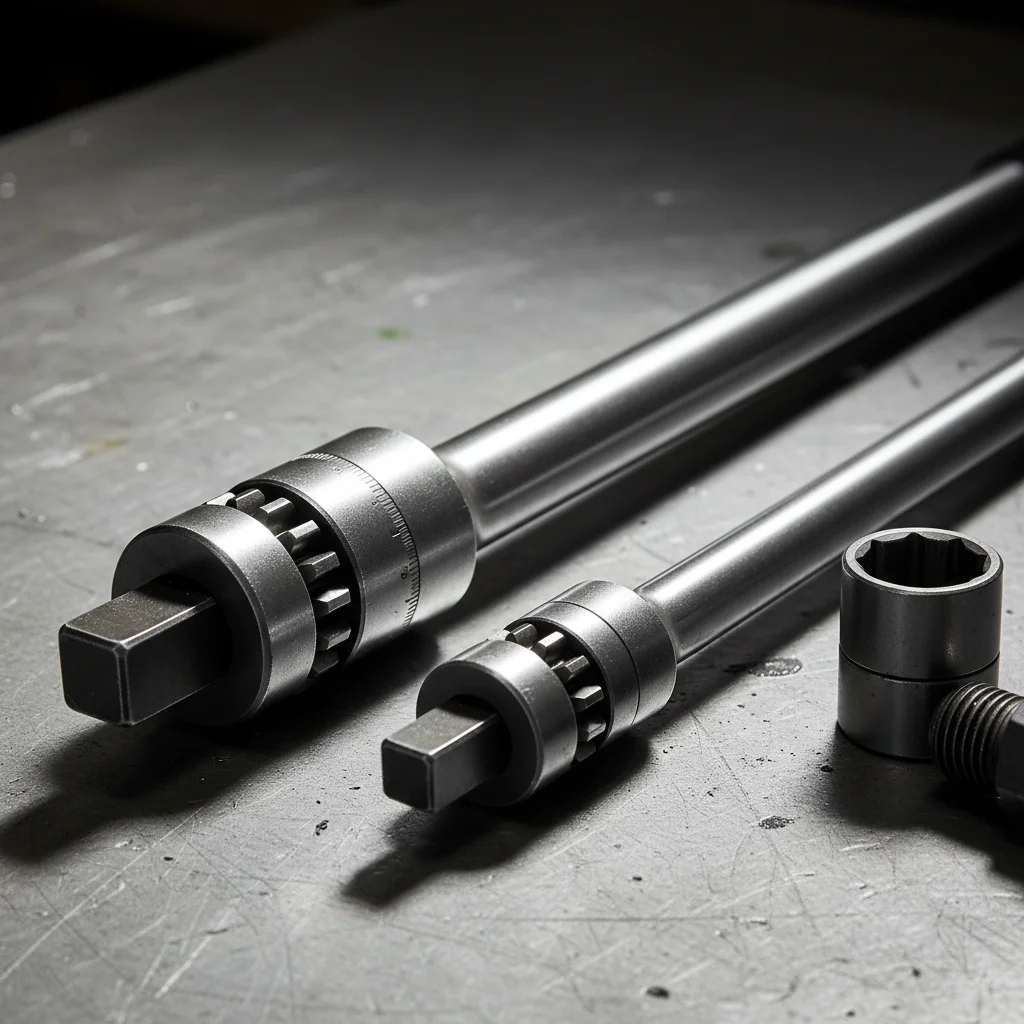
The wrench type in your hand changes everything about what that ±4% label means.
Clicker and micrometer models — the most common tools in this class — hold ±4% across the 50–300 ft-lb range. That’s acceptable for most heavy-duty work. But not all 300 ft-lb wrenches are built the same. The accuracy gap between types is wider than most people expect.
Here’s how the three main types stack up at high load:
-
Micrometer/differential (±3–4%): The TEKTON TRQ52403 tightens this to ±3% in both directions across its full 40–300 ft-lb calibrated range. Solid and consistent.
-
Electronic (±2%): The Snap-on ATECH3FR300B runs ±2% from 15–300 ft-lb, with angle measurement to 360° and a 4.5° gear arc. Tightest tolerance in the class.
-
Clicker/beam analogs (±2–4%): User reports confirm the audible click at 300 ft-lb holds accuracy. But the pre-calibrated tolerance stays at ±4%.
The Standards Gap Nobody Talks About
ASME B107.300-2021 and ISO 6789-1:2017 use different test methods. That difference matters before you buy.
|
Standard |
Test Points |
CW Accuracy |
CCW Accuracy |
|---|---|---|---|
|
ISO 6789-1:2017 |
60%, 100% |
±4% |
±4% |
|
ASME B107.300-2021 |
20%, 60%, 100% |
±4% |
±6% |
ASME tests at 20% of max torque. ISO doesn’t. That extra low-end test point is where most tools start to drift — and ASME catches it. CCW accuracy also loosens under ASME: ±6% versus ISO’s ±4%. Do your work involve left-hand loosening at high torque? That gap is real and worth knowing.
Where Errors Come From
Standards measure the wrench in a lab. Real-world use brings in more variables. Swing arc: A 90-tooth ratchet gives you a 4° arc. A 24-tooth gives you 15°. At high load, that wider arc causes precision loss the spec sheet never covers. Extension bars: Adding length changes the torque you deliver — and not in a clear, steady way. Accuracy drops well past ±4% with improvised setups.
The click is clear at 300 ft-lb. That part works. What hurts accuracy is everything else around the tool. How you hold it. What you’ve attached to it. Whether the fastener direction lines up with the wrench’s stronger tolerance direction.
Specific Fastener Specs: Real Torque Values That Demand 300 Ft-Lb

The torque spec on a fastener is an engineering decision, not a suggestion. The chart says 280 ft-lb lubed on a Grade 8, 3/4-inch bolt. That number was calculated — not estimated. Knowing which fasteners land in the 250–300 ft-lb zone tells you this wrench is the right call.
Here’s where 300 ft-lb shows up in the real world:
-
SAE Grade 8, 3/4″ bolt (dry): 375 ft-lb dry, 280 ft-lb lubed. The lubed spec falls right into the upper accuracy zone of a 300 ft-lb wrench.
-
SAE Grade 8, 7/8″ bolt (lubed): 410 ft-lb dry tops out above range. The lubricated figure pulls it back into 300 ft-lb territory.
-
SAE Grade 5, 1″ bolt (lubed): Spec runs 450 ft-lb dry. Add lubrication and that drops to about 300 ft-lb — a direct match.
-
A193 B7 studs, 300 lb flange (mid-sizes): 277–415 ft-lb with Moly lube. The lower end of that band is right where this tool is most accurate.
John Deere heavy equipment uses Grade 8, 1-inch track bolts at 300–400 ft-lb. Main frame bolts run 250–350 ft-lb. Those are real production specs, not chart extrapolations.
The Clamp Load Behind The Number
At 300 ft-lb, you’re generating serious clamping force. Take the standard formula — T = K × D × P / 12 — at K=0.15 (lubed). A 7/8-inch bolt reaches 7,900 lbs of clamp load. A 1-inch bolt hits 9,550 lbs.
That’s why getting the spec right matters. Under-torque it and the clamp load drops enough for the joint to move. Over-torque it and you’re past yield.
What Sits Just Beyond This Wrench
Class 7–8 truck wheel hubs spec at 450–590 ft-lb. Large frame bolts at 1-1/8 to 1-1/4 inch jump to 610–910 ft-lb. A 300 ft-lb torque wrench doesn’t finish those jobs — it starts them, or breaks them loose. Final torque needs a larger tool.
The fasteners that belong to this wrench are Grade 8 bolts in the 3/4″ to 1″ diameter range, lubricated mid-grade flange studs, and heavy equipment frame hardware in the 250–350 ft-lb band. That’s a specific list — and it’s a useful one.
Tool Selection Guide: Matching The Right 300 Ft-Lb Wrench To Your Job
Three variables decide whether you buy the right tool or the wrong one: wrench type, drive size, and where your target fasteners land inside the accuracy window.
Get all three right and the wrench does its job. Miss one and you’re fighting the tool instead of the fastener.
Wrench Type: Click or Electronic?
Click-type (mechanical) wrenches hit ±4% accuracy and meet ASME B107.14-2004 and ISO 6789 standards. They’re affordable, dependable for repetitive production work, and easy to use. No batteries. No firmware. Just a clean audible signal when you reach the set point.
Electronic models tighten that tolerance to ±2% in both directions, with ±1% angle accuracy on top. You get multiple modes — torque only, angle only, or torque-plus-angle — plus serialized calibration certificates. The Snap-on ATECH3FR300B is a strong example of this tier. Your job needs documented traceability or compound fastening sequences? The electronic version earns its price premium.
Drive Size: Weight and Access Trade-Offs
|
Drive Size |
Effective Range |
Weight |
Length |
|---|---|---|---|
|
1/2″ |
Mid-range automotive |
4.51 lbs |
27.1 in. |
|
3/4″ |
Heavy-duty industrial |
9.95 lbs |
33.75 in. |
|
X Shank |
Preset production lines |
3.9 lbs |
27.7 in. |
The 3/4-inch drive handles 300 ft-lb with no trouble. The 1/2-inch does not — 250 ft-lb is its ceiling, as covered earlier. In tight engine bays, the 3/4-inch’s extra 6 inches and 5 additional pounds start working against you fast. Know your workspace before you commit.
The Accuracy Window Problem
This is where most buyers go wrong.
A 50–300 ft-lb wrench is most accurate between 60–300 ft-lb — the 20% to 100% zone. Drop below that and precision erodes. A 50 ft-lb fastener on this wrench runs at 17% of range. That’s outside the reliable zone.
The fix is simple: run two wrenches instead of one. 20–150 ft-lb wrench for lower-torque fasteners. 50–300 ft-lb wrench for everything in the upper band
Say your job mixes 50 ft-lb, 150 ft-lb, and 280 ft-lb fasteners. A single 300 ft-lb tool pushes the lightest fastener into its worst accuracy zone. Split the work instead. Each fastener stays inside the 60%+ band for whichever tool handles it. That keeps your readings solid across the board.
One wrench feels simpler. Two wrenches get the job done right.
Common Mistakes That Damage Fasteners (And The Wrench Itself)
Ninety-five percent of fastener failures happen during installation — not because someone grabbed the wrong bolt.
That number should change how you think about a 300 ft-lb torque wrench. The tool isn’t just sitting there passively. How you use it decides whether the fastener holds or fails.
The Four Mistakes That Cost You Fasteners
Over-tightening is the obvious one, but the damage isn’t always easy to see. You strip threads. You create stress fracture points. Sometimes you break the fastener clean off during assembly. The worst version is hidden thread peeling — the joint looks fine until load hits it. Then it fails.
Under-tightening does the opposite. No preload means the joint can separate under vibration or shock. Tightening the bolt head instead of the nut drops clamping load by 10–15%. That’s a real loss, and most people never catch it.
Extension bars without math are a serious problem at this torque range. A 36-inch bar on your wrench can push actual output 30–50% above the dial reading. A 200 ft-lb reading becomes 260–300 ft-lb delivered. Wheel studs get stripped. The formula matters: Actual torque = wrench reading × (1 + extension length ÷ fastener distance to load axis). Run those numbers before you apply torque.
Reusing worn fasteners makes every other mistake worse. Wheel studs start losing solid clamping strength around 120,000 miles. Threads soften. Friction rises. The fastener can’t hold spec torque anymore — no matter what your wrench reads.
What Kills The Wrench Itself
-
Maxing out too often: Running a 300 ft-lb torque wrench at 280–300 ft-lb cycle after cycle grinds down the ratchet pawls fast. Keep usage under 80% of max. Take breaks every 10–20 cycles to let the tool recover.
-
Storing under tension: A spring held compressed for months loses calibration. Zero the wrench after every use. Store it hanging — not set flat with tension on the spring.
-
Skipping calibration: Annual recalibration — or every 5,000 cycles — is the standard. Skip it, and torque error can drift to ±10–20%. That’s enough to cause real fastener failures.
Conclusion
A 300 ft-lb torque wrench doesn’t try to do everything — and that’s what makes it so effective at what it does do. Lug nuts, axle shafts, heavy equipment fasteners, structural bolts — this is the torque range where precision matters most. Under-torquing in this range carries real consequences.
Know your fastener specs before you grab any tool. A wrench rated at 300 ft-lb is capable in the right hands. But push it below 20% of its range — or past its rated capacity — and precision turns into guesswork.
Pick the drive size that fits your actual work. Match the wrench type to the environment. Schedule calibration on a regular basis.
That’s not overthinking it. That’s just using a serious tool the right way.
Now go check the torque specs on that job sitting in your garage. Chances are, a quality 300 ft-lb wrench is the right tool for it.
